
Why “Just Check More” Doesn’t Work with Agentic AI
AI made deliverables cheap to make. Then quality problems showed up. Telling each person to check their own AI output more isn’t enough to give a team better outcomes over time. That takes rethinking how people and AI agents work together: who checks what, who answers for the result, and how one correction reaches everyone it touches.

01 / 0:17
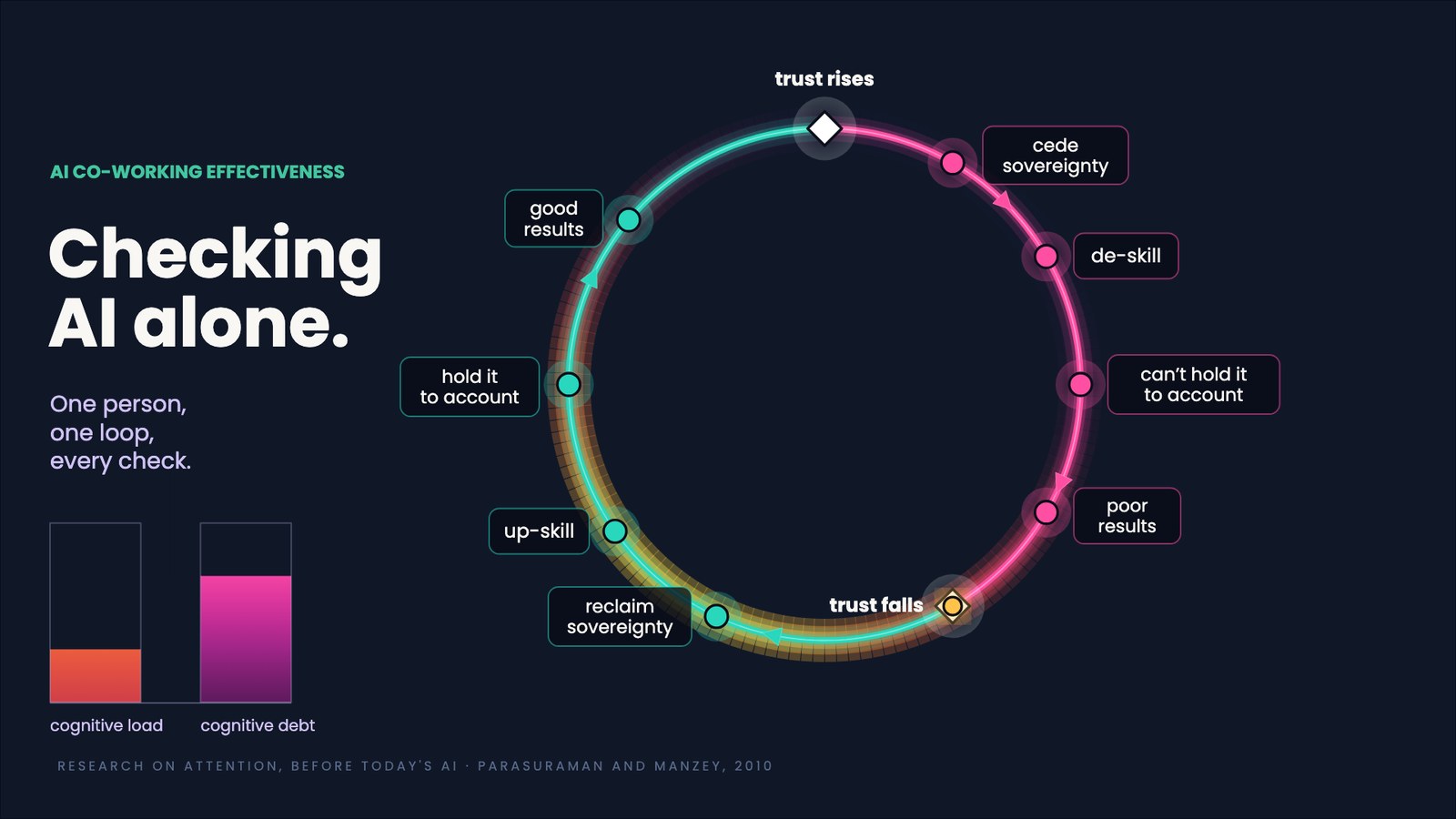
Checking AI alone
Research on attention, from before today’s AI, says watching over automation is something people do badly.
So each of us checks our own AI work, alone. Research on attention from before today’s AI is not encouraging. Parasuraman and Manzey (2010) found that watching over automation while doing other work breeds complacency, in experts as well as beginners, and that simple practice does not overcome it. People also learn to go along with the machine, and training or instructions do not prevent that.
None of that is a character flaw. It is how attention works, and it was true before AI could draft a policy in a minute.
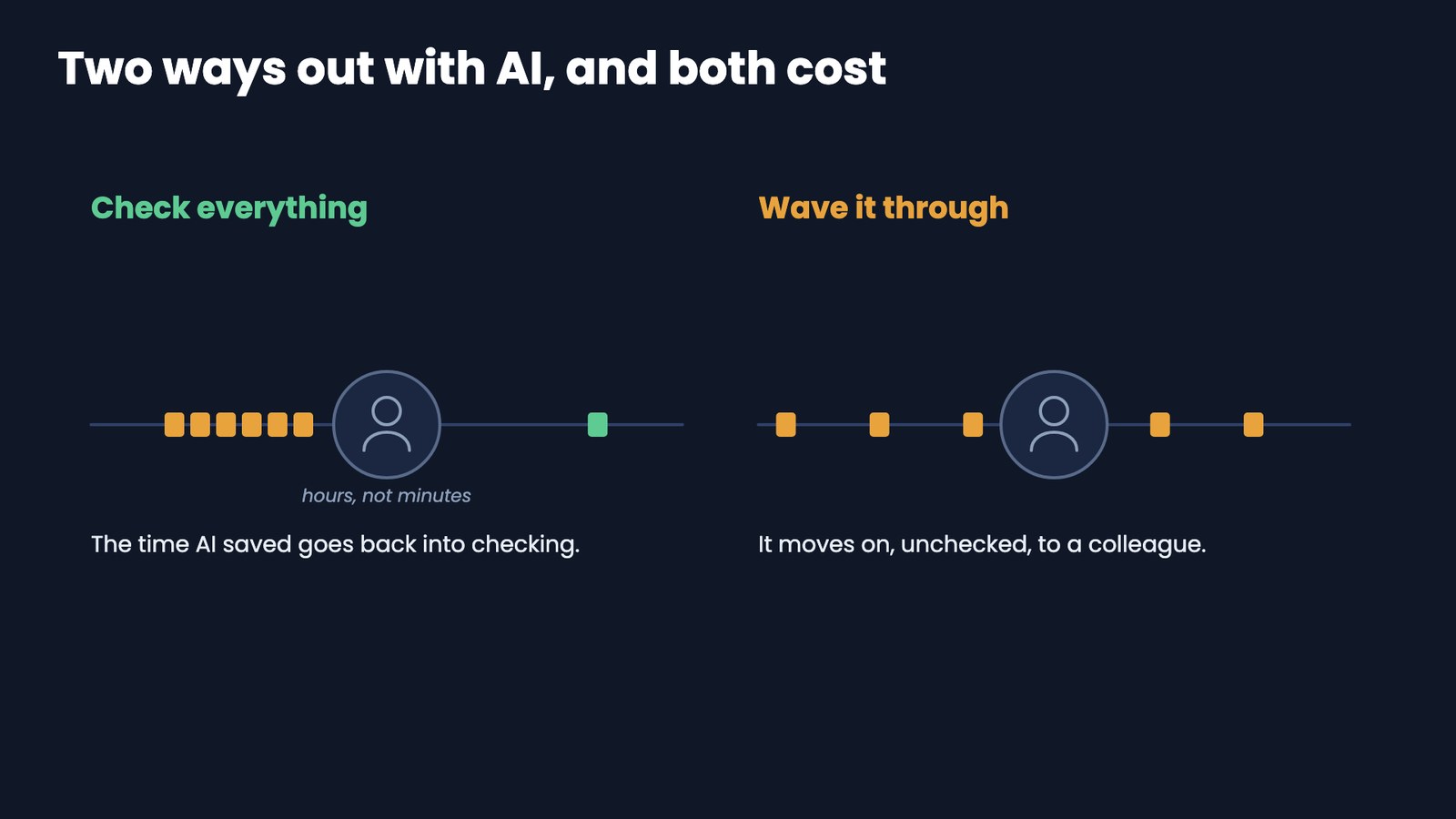
That leaves two ways out. Check everything in great detail, all by hand, and the time AI saved is eaten up by the checking. Or wave it through, and pass it on.
03 / 0:53
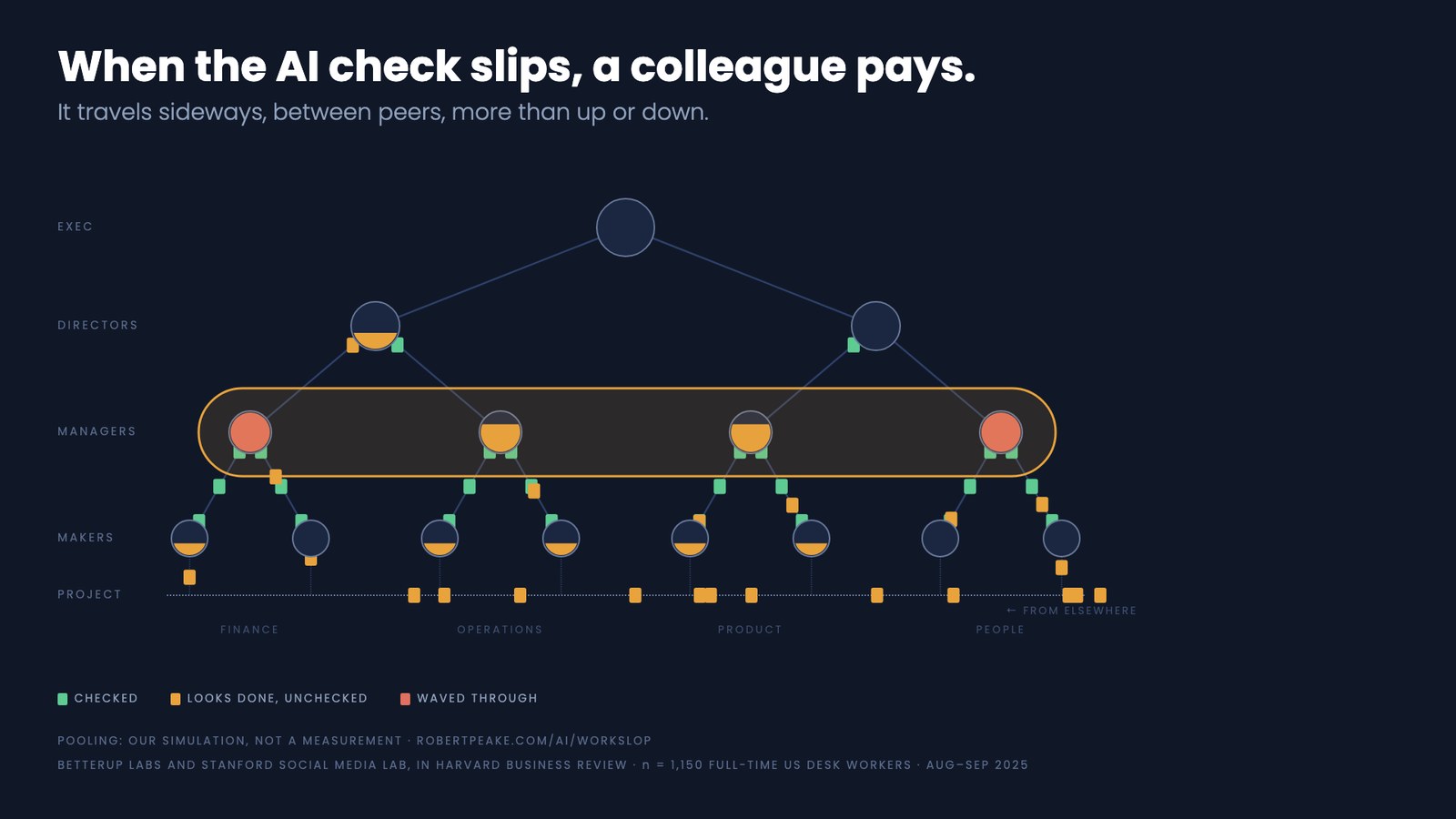
When the check slips, a colleague pays
40% of desk workers said they had received AI workslop in the last month.
When the check slips, the cost often lands on a colleague. In a survey of 1,150 full-time US desk workers in August and September 2025, published in Harvard Business Review, 40% said they had received AI workslop in the last month: work that looks finished but doesn’t hold up. Each one took nearly two hours to deal with, and about half saw the sender as less capable and less reliable as a result.
It travels sideways, up and down. In our own simulation of those flows, it pools on middle managers. That part is a model, not a measurement, and the workslop explainer sets out how it was built.
04 / 1:24
A method, not an after-the-fact check
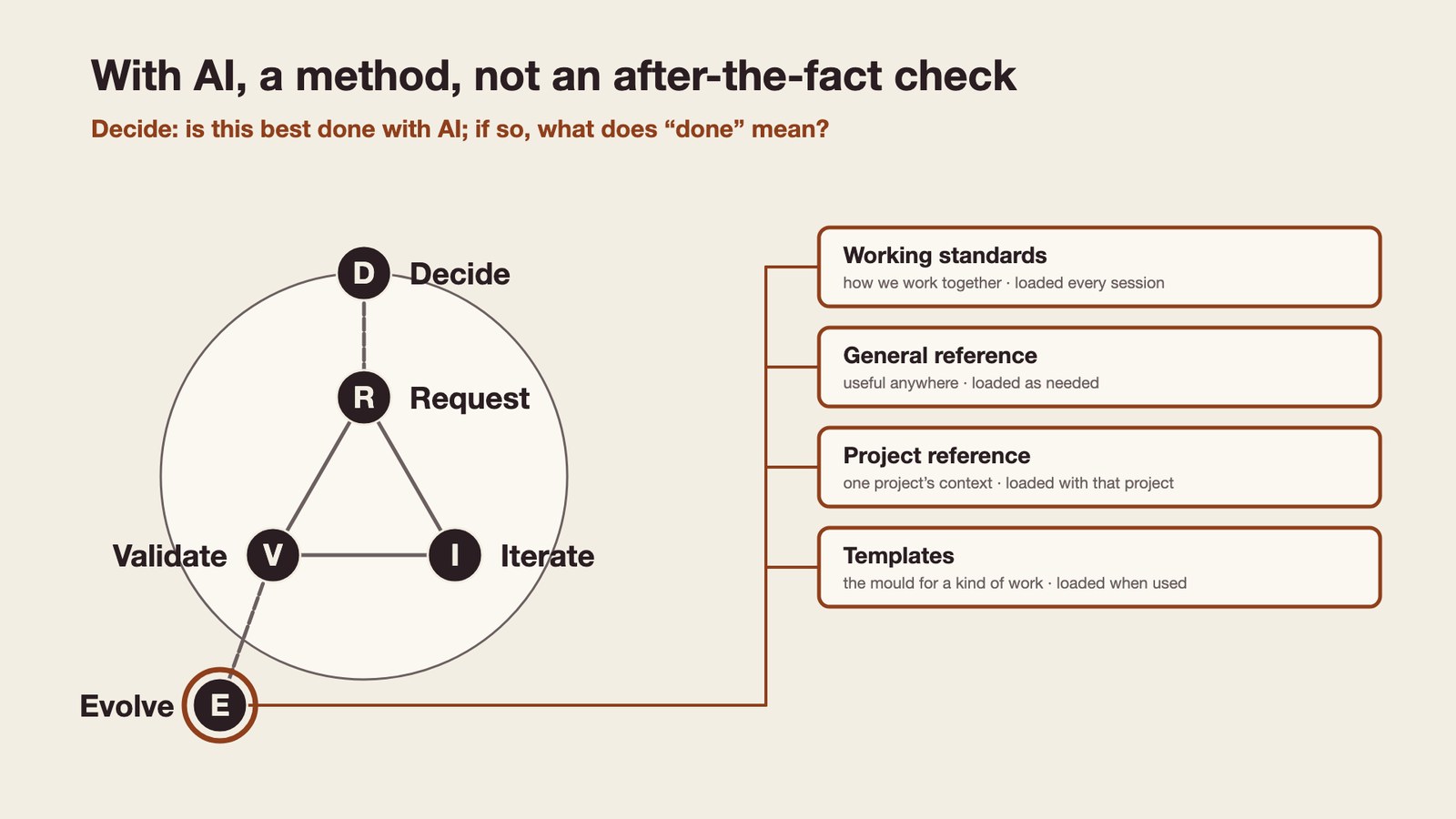
DRIVE for each person: Decide, Request, Iterate, Validate, Evolve.
The answer is a method for ensuring quality, not an after-the-fact check. I call it DRIVE. It starts with Decide: is this best done with AI, and if so, what does “done” mean? Then make the Request, Iterate through revisions, and Validate against what you decided.
Then Evolve: what you learned goes where it will be used next time, into working standards, general reference, project reference or templates. Both your practice and your AI working environment get better with each piece of work.
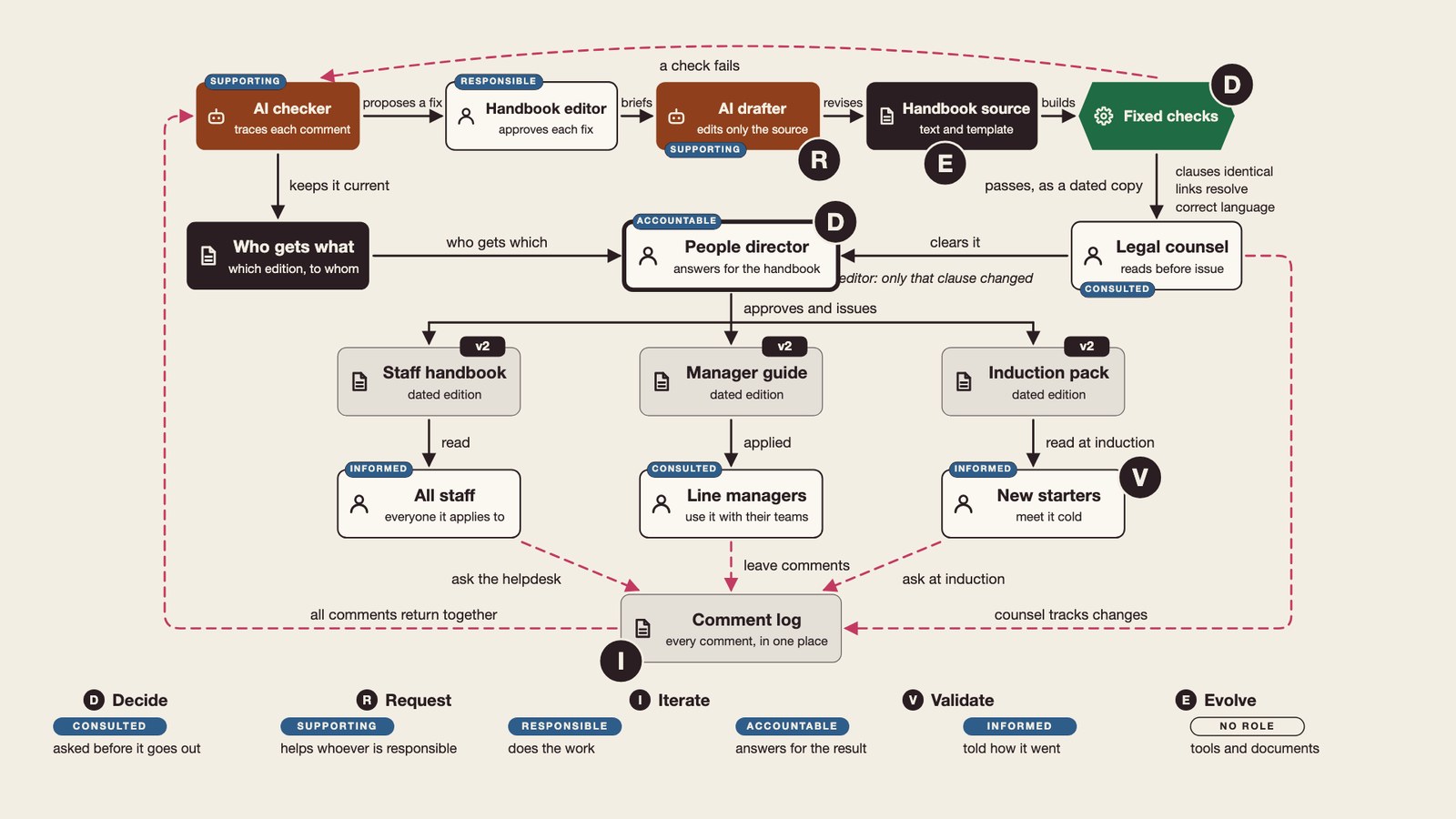
Run by a team, the same loop opens out. Take a people team that keeps one handbook in three editions: for all staff, for line managers, and for new starters.
- Decide helps create fixed checks and sign-offs, based on a clear understanding of what “done” means before the work starts.
- Request is the editor’s brief to the AI drafter.
- Iterate is the editor and the agent going round, then updating a comments and changes log that everyone can see.
- Validate is layers of checks: automated checks for matching clauses, working links and correct language, then legal counsel, then feedback from the people who actually use it.
- Evolve is where the whole procedure gets updated and refined over time.
06 / 2:32
One policy change, every role
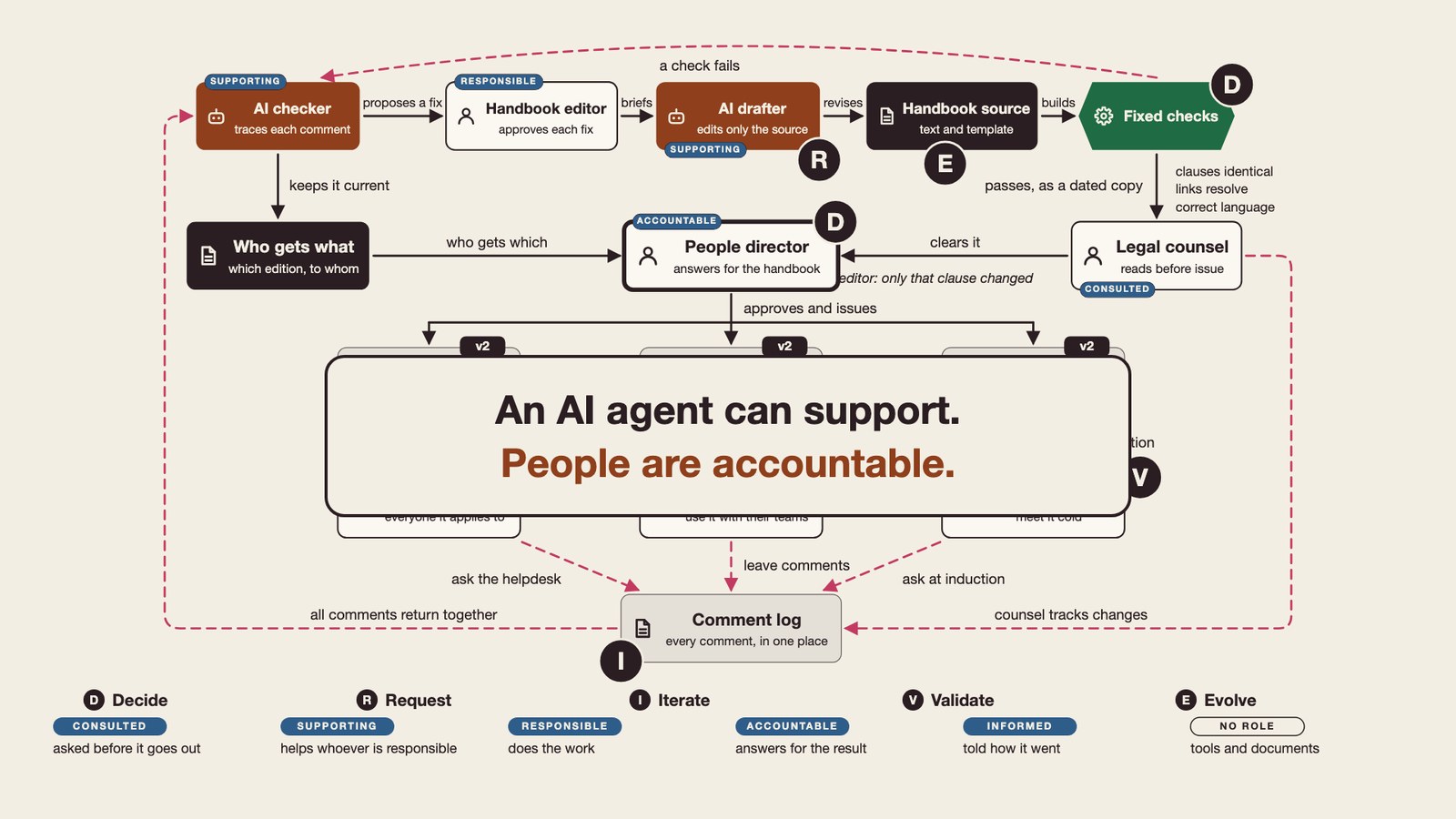
Accountable is always one named person. An AI agent can support. People are accountable.
Follow one policy change. A line manager, consulted on the guide, notices it refers to an outdated policy that leadership has overturned. The AI checker, supporting, traces it to the one clause all three editions share, consults past precedents for wording and tone, and proposes a fix. The editor, responsible for the work, approves it and steers the AI drafter toward the defined deliverable.
The automated checks pass, legal counsel gives the OK, and the people director, accountable for the handbook, reads the log of changes and the checklist of approvals before issuing the new editions. A who-gets-what list, also kept current by AI, sends them to all staff and new starters, who are informed.
All three editions now say the same thing, and everyone has the new information without anyone hunting down documents, puzzling over the perfect wording, or passing drafts around for feedback in a flurry of documents and messages.
The roles follow RASCI: accountable answers for the result, responsible does the work, supporting helps whoever is responsible, consulted are asked before it goes out, and informed are told how it went. An agent can support, and can be responsible for a single task, but it is never accountable. Fixed checks and documents hold no role.
The approach is built to share the load, keep the time AI saves, and foster teamwork and trust.
07 / 3:52
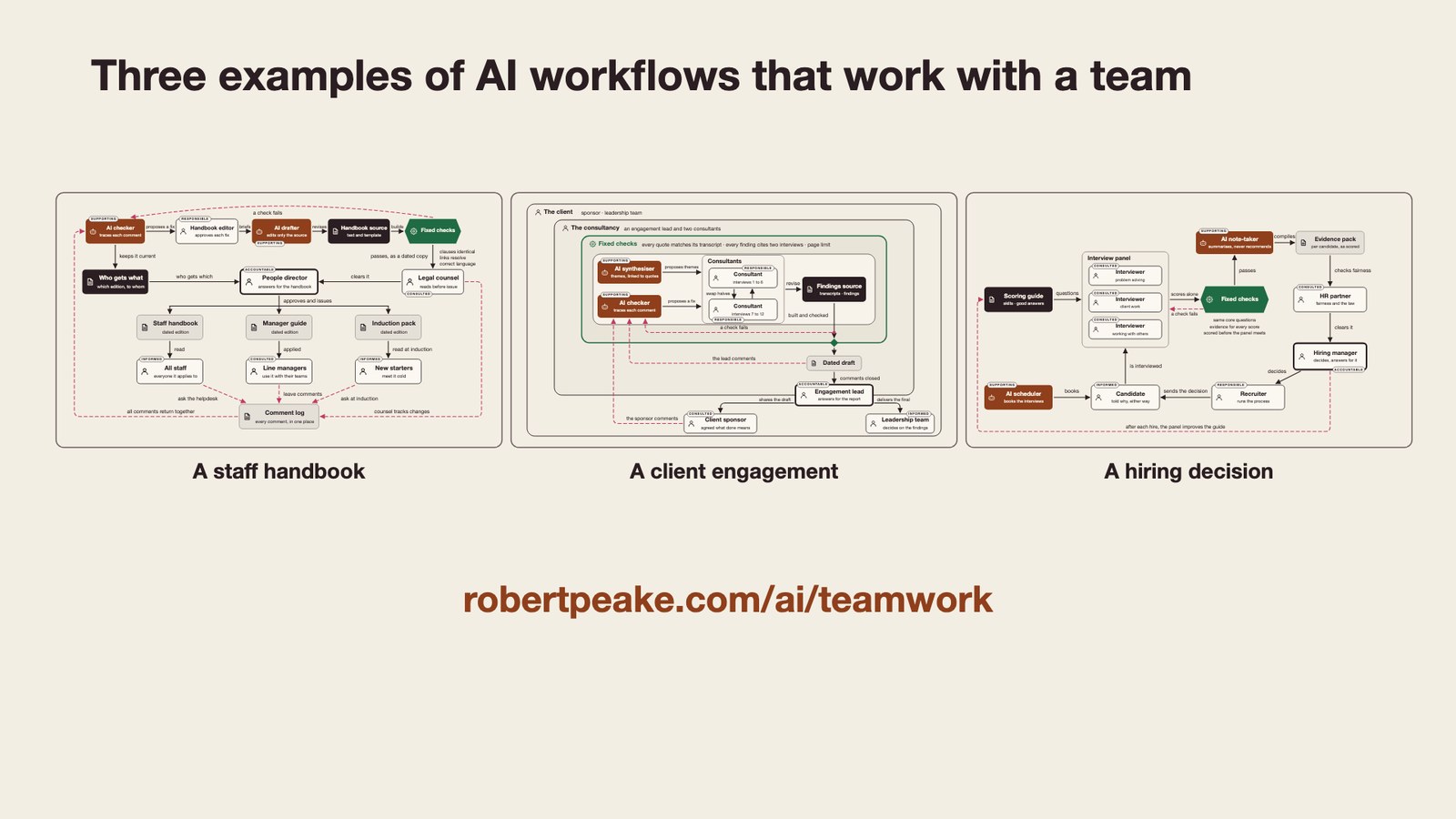
Three examples of AI workflows that work with a team
A staff handbook, a client engagement, and a hiring decision.
The handbook is one of three workflows I have drawn this way. The others are a client engagement with one deliverable, and a hiring decision. Each applies DRIVE, decides the roles for both people and agents, and maps out the workflow, so a team can realise the promise of AI automation with confidence.
AI doesn’t have to downgrade dynamic teams into a collection of silos of one. With the right mindset and methods, our quality, efficiency and team spirit can all rise at once.
The everyday practice
DRIVE: five steps for working with AI
DRIVE is the method underneath every workflow on this page: Decide what done means before you start, Request with the context it lacks, Iterate while you still hold the thread, Validate before it leaves you, and Evolve what you learned into how the next piece of work begins.
Work on AI with your team
I run AI effectiveness programmes for teams and organisations, grounded in how our minds really work: a whole-team picture of where people actually sit, DRIVE in everyday practice, workflows where every person and agent has a role, and a promotion path so that what one person learns becomes what everyone can use. If that would be useful, get in touch and we can talk about what your team needs.
Or find out where you stand with AI today
The Cognition Survey is the instrument at the start of the programme. It is free, anonymous, takes about eight minutes, and it will not flatter you. You get a detailed report on where you land, and where the opportunities are.
Related: DRIVE, the method for one person; AI Workslop and the Slop Seep, where the checking goes; The Trust Trap, the loop in depth; How AI Work Keeps Its Judgment, the workspace kit
Narration: my own voice, generated with a local voice clone.
References
Complacency and going along with the machine
Parasuraman, R., & Manzey, D. H. (2010). Complacency and Bias in Human Use of Automation: An Attentional Integration.
Human Factors, 52(3), 381-410.
The survey behind every measured figure
Niederhoffer, K., Kellerman, G. R., Lee, A., Liebscher, A., Rapuano, K., & Hancock, J. T. (2025).
AI-Generated “Workslop” Is Destroying Productivity. Harvard Business Review, 22 September 2025.
BetterUp Labs and the Stanford Social Media Lab; n = 1,150 full-time US desk workers, August to September 2025.