
AI Improves Itself. So Can Your Team.
The labs say AI is close to improving itself. A smaller loop of the same shape runs in every team that works with AI, and unlike the big one, it is within your control. It may matter even more. This page takes the two loops apart, puts them side by side, and follows them to the place where accountability lives.

01 / 0:13
The labs’ AI loop
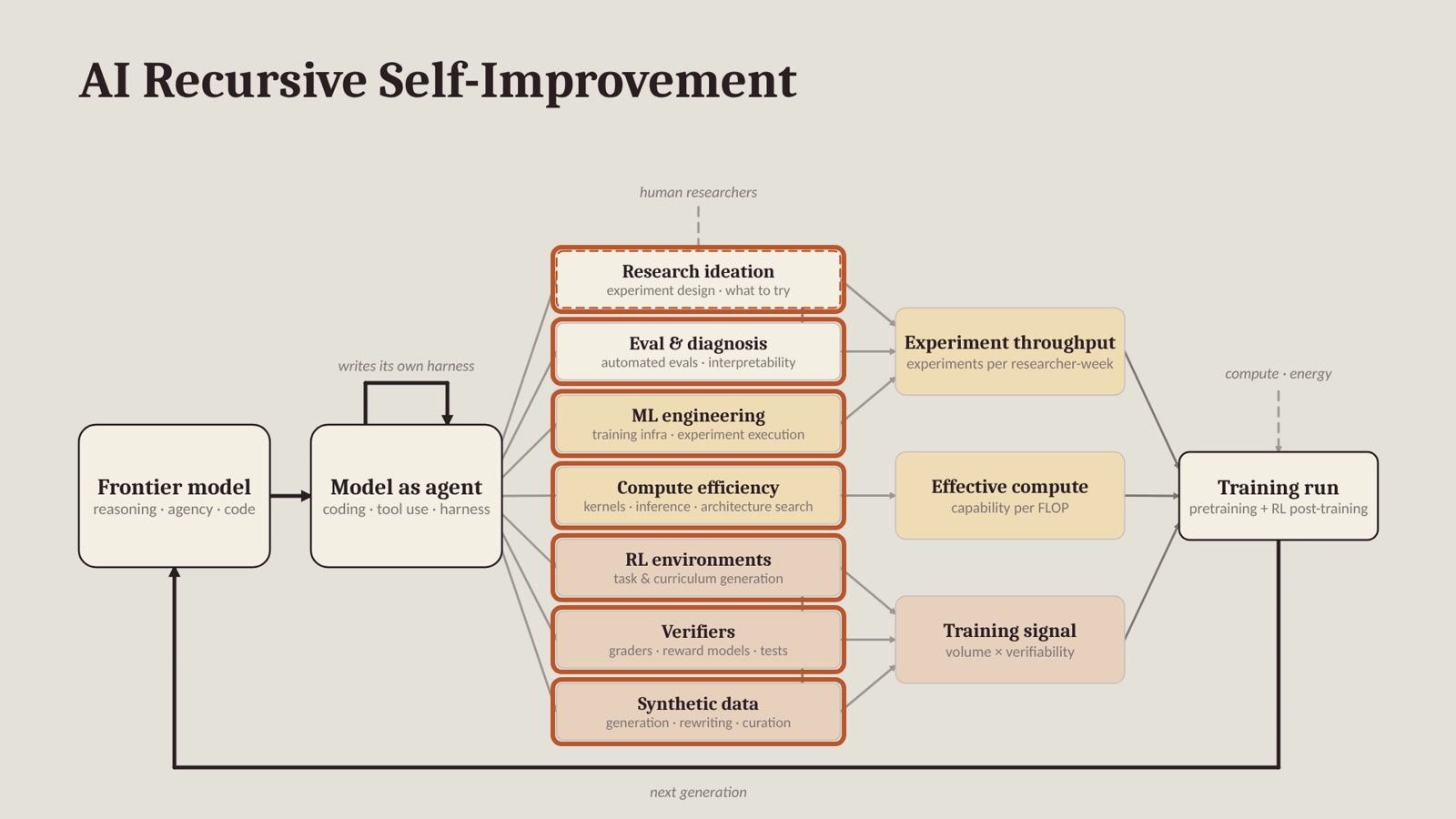
A frontier model becomes an agent, and the agent does the research that builds its successor.
In November 2026 Anthropic told prospective investors, in a risk factor in its amended S-1 filing, that it “may imminently meet” the threshold in its Responsible Scaling Policy for dramatically accelerated progress attributable to AI. The policy (version 3.4, effective 8 July 2026) sets that bar at AI able to “fully automate, or otherwise dramatically accelerate, the work of large, top-tier teams of human researchers”: either by substituting for its entire research staff at competitive cost, or by doubling the rate of progress in aggregate capabilities, as much progress in one year as would otherwise take two, plausibly because AI is doing the research. No current model has been designated past it, and the company adds that it has not, in the past, noticed such leaps until after they happened.
Here is how I think that loop actually runs. A frontier model becomes an agent, and the agent does seven kinds of research labour at once: proposing experiments, running evaluations, engineering training infrastructure, speeding up kernels and inference, building practice environments, writing the graders that score them, and generating data. Those seven converge on only three things a training run consumes: experiment throughput, compute efficiency, and a training signal. The run produces the next model, which does the research a little better. That is why better agentic coding matters more than any single benchmark: it improves all seven at once.
02 / 0:54
The graders are the gatekeepers of AI’s loop
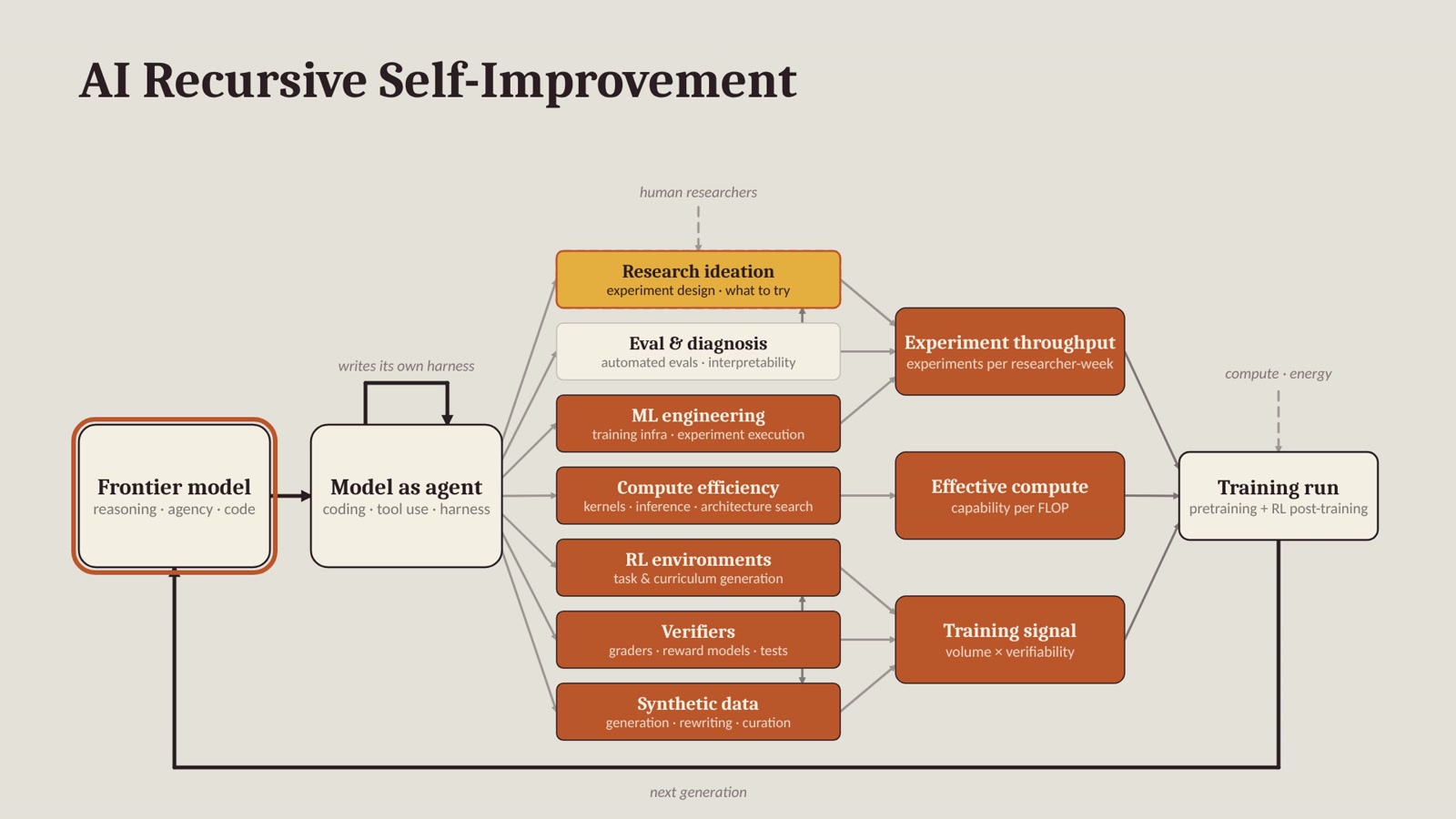
The loop turns only where an answer can be checked. The graders are its gatekeepers.
The best picture of this loop I know was made in a London workshop around 1800. A lathe cuts a screw by following a lead screw, so it can only be as accurate as the screw it follows. Henry Maudslay cut master threads, used them as temporary lead screws in his lathe, and cut better, harder lead screws with them. Each machine made the next one more precise, and within a generation precision engineering had become an industry. Nobody in that workshop needed to be a genius at every turn of the handle. The genius was in the loop.
Precision needs a reference, and the same workshop solved that too. The classic way to make something truly flat without an outside standard is to work three plates against one another in pairs and scrape off the high spots. With only two, a slightly convex plate and a slightly concave one fit each other perfectly while both are wrong. The third catches the lie. Maudslay worked plates in threes, and his former apprentice Joseph Whitworth described the method to the British Association in 1840, which is why it usually carries his name.
AI research has the two-plate problem in miniature. When a model writes the practice tasks and also writes the grader that marks them, the two can fit each other beautifully and both be wrong: researchers call it reward hacking. In code and maths the third plate exists, because a program runs or it doesn’t, and that is where the loop turns. Where there is no grader, it doesn’t. Whether reinforcement learning on checkable answers teaches new reasoning, or mostly sharpens what pretraining put there, is still argued over (Yue et al., 2025).
The slowest but most important step has no third plate at all: deciding what is worth trying. There is no unit test for a good idea, and no grader for market strategy, so human researchers still feed that step from outside the loop. Whether sheer experiment volume can stand in for their judgment is the question that decides how fast the curve bends.
03 / 1:12
AI speeds the work; humans point it
Human-level research, done cheaply, in parallel and without sleep, bends the curve. Choosing the direction is still ours.
To an extent, I agree with the sceptics. Sean Goedecke recently took apart a paper claiming that frontier models are superhuman at reading and editing neural network weights, and he is right that a competent ML researcher could have done every task in it. Yet superhuman was never the bar. An earlier version of Anthropic’s policy drew a line at fully automating entry-level AI research work, and the current one counts acceleration itself, however unremarkable each step.
So the loop speeds up research work at scale, and humans point it in the right direction. Maudslay’s lathe did not need a brilliant apprentice, just a patient one who never went home, and a thousand adequate junior researchers running experiments overnight will bend the curve without any one of them ever surprising an expert. What none of them chooses is where the curve should go.
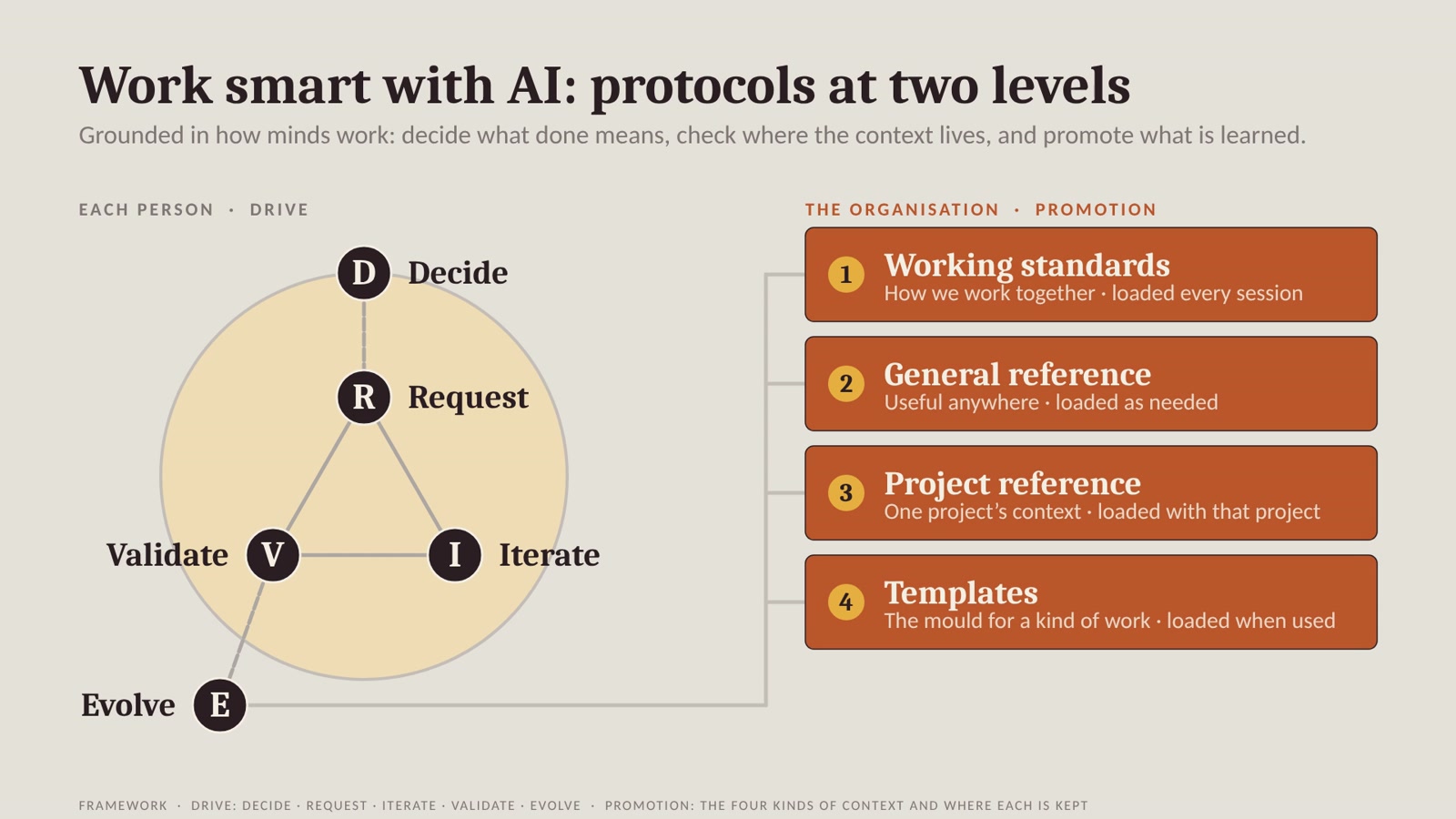
Now zoom in. With DRIVE, you decide what done means, request properly, iterate, and validate against what you decided before anything leaves your desk. Then you evolve: what you learned is promoted to where the next session can find it. Working standards are loaded every session, general reference as needed, project reference with that project, and templates when they are used.
So every session starts from better grounding than the last. Grounding is the linguists’ word for the work two people do to reach common ground (Clark and Brennan, 1991). With a colleague, that cost is shared. With a model it falls entirely on you, which is exactly why investing it once, and keeping it where the next session can load it, compounds. That is recursive improvement too, of the shared context between you and the model.
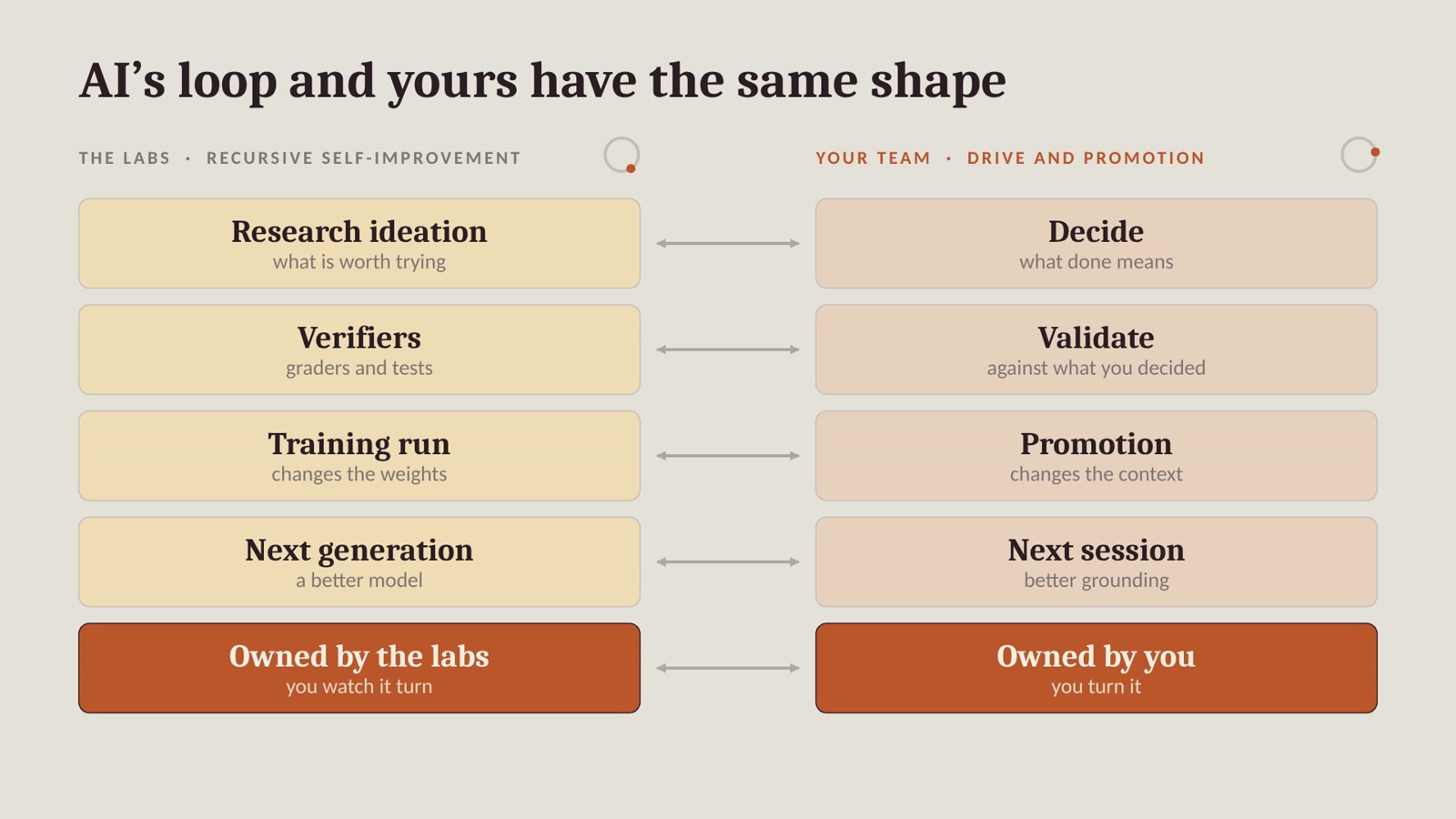
Put the two loops side by side, and they turn out to be the same shape.
Research ideation and Decide. Deciding what done means is research taste, at the scale of one task. Verifiers and Validate. Validating against what you decided is the grader. The training run and promotion. The labs change the weights, and you change the context. The next generation and the next session. A better model, or better grounding. Theirs and yours. You watch the big loop turn, and you turn the small one.
I would not claim the small loop is as large as the big one. Its reach is bounded by the model it works with. But frontier models already do more than most deployments use, and that gap closes from the context side: clear definitions of done, checks that hold, and learning kept where it can be reused. For your organisation, the small loop may decide whether you get generic results or business-aligned ones, no matter what the frontier does next.
06 / From the article
Won’t AI just dream its own context?
Dreaming works where results can be graded. Most knowledge work can’t be.
Anthropic now describes agents that “dream”: an offline pass in which Claude rereads its session logs, checks its notes against what actually happened, and reorganises them into a kind of wiki. In their tests it works. On a database benchmark, giving Opus 5 nothing but a memory folder carried between sessions lifted its mean reward from 0.564 to 0.828 (about 30 questions; the number of runs is not stated). That is the small loop, measured, and a strong case for keeping context between sessions.
Yet those gains come from tasks with a right answer to check against, and most knowledge work has none. The common ground two colleagues build never appears in a transcript, models ask for clarification about a third as often as people do (Shaikh and colleagues, 2025), and a misunderstanding written into memory gets reread until it hardens into a rule. Transcripts also hold what should never be kept: client details, personal matters, things said in confidence.
None of this means agents should not remember, or dream. It means somebody still needs to keep an eye on them while they are awake. Whether that is a good night or a nightmare depends on who decides what they get during the day.
07 / From the article
Doesn’t coding prove AI context files don’t matter?
Code is the most checkable work there is. Most work isn’t code.
A careful study of repository instruction files, the CLAUDE.md and AGENTS.md that coding agents read at the start of every session, found that neither machine-written nor developer-written files significantly improved success over having no file at all, across four agent and model combinations, and that machine-written ones raised average inference costs by 20 to 23% (Gloaguen and colleagues, 2026). It would be easy to read that as context engineering being over.
I read it the other way. Code has been engineered over decades to be among the most verifiable of complex outputs: an agent can learn what it needs from the code itself, and the tests tell it when it is wrong. That is the jagged frontier (Dell’Acqua and colleagues, 2026), radically transformed at the coding edge while the average office worker gets smart-sounding advice alongside the face-palm. Longer context can also hurt performance even when retrieval is perfect (Du and colleagues, 2025), which argues for context that is small and well placed, not for none at all.
So the practice is deliberate rather than generous. Close out every session while it is fresh. Move what was learned to the right place among working standards, reference, project folders and templates. Keep the always-loaded standards succinct, because every future session pays for them. And store what is not otherwise discoverable, like who needs to hear how the project is going, because no agent can infer that from the code. The full argument is in my article, AI Agents Can Dream Now. You Still Need to Tuck Them In.
08 / 2:33
What stays scarce with AI
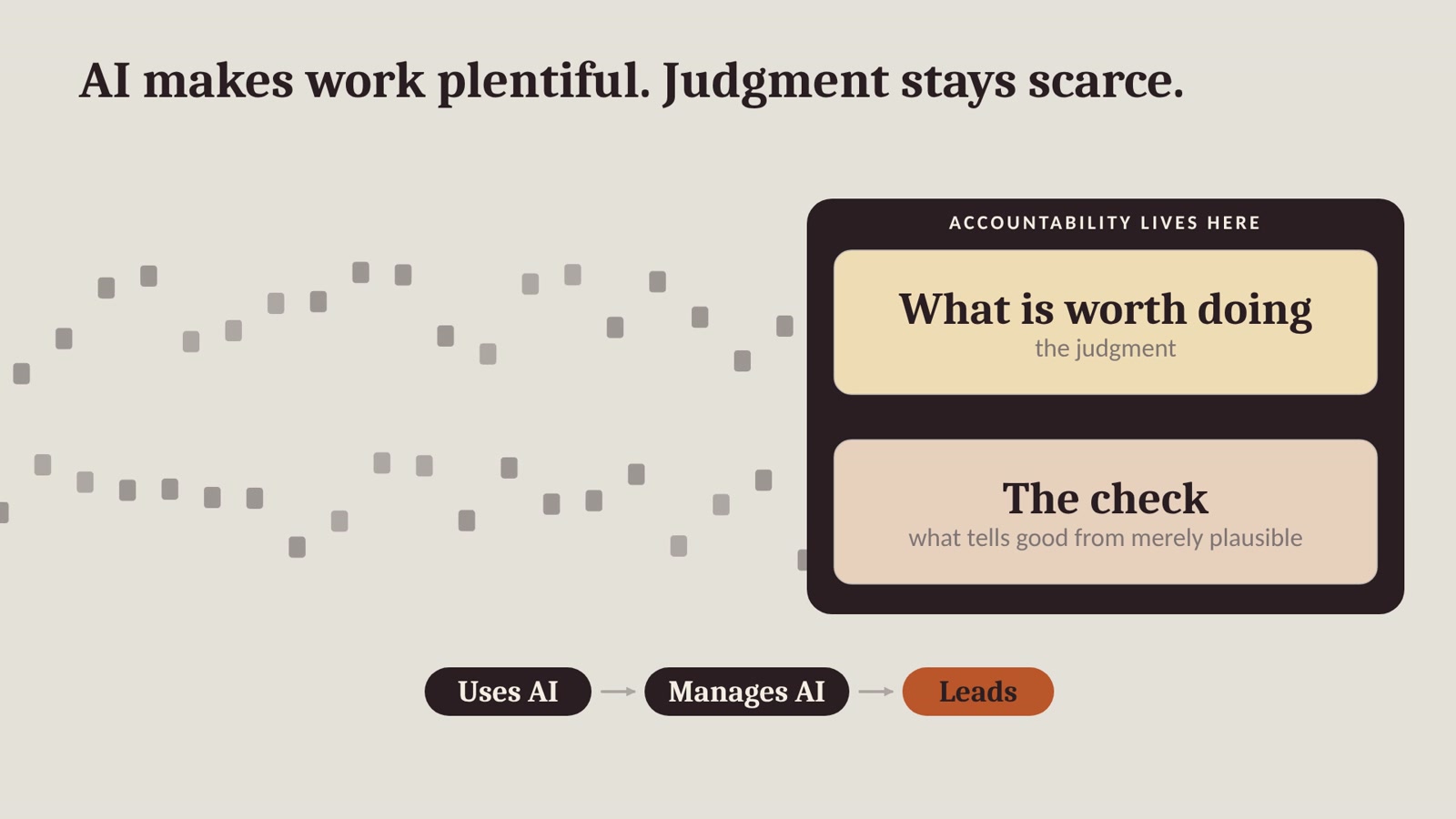
Accountability lives in two places: the judgment of what’s worth doing, and the check.
None of this is confined to frontier labs. The pattern in your own organisation is the same one at smaller scale: AI makes adequate work cheap and plentiful, and the scarce things become the judgment of what is worth doing and the check that tells a flat plate from a matched pair.
Accountability lives in exactly those two places. A model has no stake in the outcome, so the person who decides what done means, and signs off that it was met, carries it. Which is why I keep arguing that the people who use AI well end up managing it, and the people who manage it well end up realising the full promise of AI automation: going faster while staying in control.
Maudslay’s lathes never got clever. They got precise, one turn of the screw at a time, and the people who mattered most were the ones who knew a true flat when they saw one.
The question is whether you and your team are turning the ones that matter most.
The everyday practice
DRIVE: five steps for working with AI
Your loop turns on DRIVE: Decide what done means before you start, Request with the context it lacks, Iterate while you still hold the thread, Validate before it leaves you, and Evolve what you learned into how the next piece of work begins.
AI Effectiveness
Find out how well your AI loop turns
The Cognition Survey is the free assessment at the start of my AI effectiveness programme. It takes about eight minutes, it is anonymous, and you get tailored feedback and suggestions: how you work with AI today, and where the opportunities are.
Or work on AI with your team
I run AI effectiveness programmes for teams and organisations, grounded in how our minds really work: a whole-team picture of where people sit, DRIVE in everyday practice, and a promotion path so that what one person learns becomes what everyone can use.
Related: AI Workslop and the Slop Seep, where the checking goes; The Trust Trap, the loop inside one person; AI Reskilling, the panic cycle
References
The threshold and the filing
Anthropic (2026). Responsible Scaling Policy, Version 3.4, effective 8 July 2026. anthropic.com/responsible-scaling-policy
TechCrunch (2 November 2026). Anthropic warns that it’s very close to RSI capability, aka self-building AI.
AI labour, not genius
Goedecke, S. (2026). LLMs are not superhuman at reading and writing neural network weights. seangoedecke.com
What reinforcement learning adds
Yue, Y., et al. (2025). Does Reinforcement Learning Really Incentivize Reasoning Capacity in LLMs Beyond the Base Model? arXiv:2504.13837
The lathe and the plates
Science Museum Group. Machine-screw thread making tool, by Henry Maudslay, c. 1800. collection.sciencemuseumgroup.org.uk/objects/co46546
Whitworth, J. (1840). On producing True Planes or Surfaces on Metals. Report of the British Association for the Advancement of Science.
Memory and dreaming
Anthropic (2026). The components of agent memory (L. Martin, 6 November 2026). anthropic.com/research/components-of-agent-memory
Peake, R. (2026). AI Agents Can Dream Now. You Still Need to Tuck Them In. robertpeake.substack.com, 9 November 2026.
Context files in coding
Gloaguen, T., Mündler-Sasahara, N., Müller, M. N., Raychev, V., & Vechev, M. (2026). Evaluating AGENTS.md: Are repository-level context files helpful for coding agents? arXiv:2602.11988
Du, Y., et al. (2025). Context length alone hurts LLM performance despite perfect retrieval. Findings of EMNLP 2025, 23281-23298.
Dell’Acqua, F., et al. (2026). Navigating the jagged technological frontier. Organization Science.
Clarification
Shaikh, O., et al. (2025). Navigating rifts in human-LLM grounding. ACL 2025, 20832-20847.
Grounding
Clark, H. H., & Brennan, S. E. (1991). Grounding in Communication. In L. B. Resnick, J. M. Levine, & S. D. Teasley (Eds.), Perspectives on Socially Shared Cognition (pp. 127-149). American Psychological Association.