Li-Young Lee’s Compelling Tenderness

“…at once it struck me, what quality went to form a Man of Achievement especially in literature & which Shakespeare possessed so enormously–I mean Negative Capability, that is when man is capable of being in uncertainties, Mysteries, doubts without any irritable reaching after fact & reason”
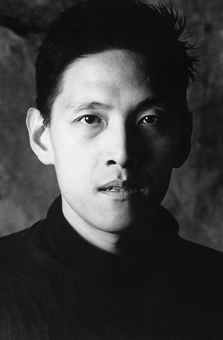
What struck me most about both The City In Which I Love You and Rose was Lee’s tenderness. It is not softness per se or looking only on the gentler side of things–far from it, his poetry encompasses, contains and holds moments of profound suffering and injustice sharply in its lens. Yet there is a quality of seeking to understand the human side of everything this poetry looks upon. This is a compelling kind of tenderness–not the tidy, maudlin tenderness of Hallmark greeting cards, but a profound ability to look lovingly and longingly at the deeper themes of life, which are necessarily complex and unresolved.

I find satisfaction in Lee’s poetry through its sensitive details. He seems to let me in unflinchingly to his most intimate moments. Yet despite such vulnerability, he never steers the experience toward any overt manipulation of what I should feel or think–the dignity of that burden is left solely with me. By focusing on detail in a spare and careful way, and resisting any urge to tie things up too neatly, Lee’s poems ring with an incredible veracity, and leave me feeling as though I have experienced, briefly, another’s life.

For example, this is part of the final section of “My Sleeping Loved Ones” from Rose:

More than the cheekbones I inherited from my mother,
more than my left hand, the spear,
or my right hand, the hammer, more
than humility, like my father’s heavy hand
on the back of my neck,
it is my love
for the sleeping ones
which recommends me.


Here multiple complex layers of experience are compressed and held together by this unifying maternal instinct of tenderness toward sleeping loved ones. Lee describes the hammer and spear of his hands, a motif of Tae Kwon Do and a nod to the warlike elements of his ancestry. Then the hand motif shifts to this incredible moment of describing humility as his father’s heavy hand on the back of his neck–a perfect symbol of a kind of enforced humility from a father who we know, from other poems, suffered so greatly as to overshadow Lee’s experience oppressively. So mother, father, culture–and loved ones present and past–collide in a few short lines of plainspoken verse.

Such deceptively simple lines rarely come from calculation. Instead, Lee’s work has a feeling of deep contemplation, and whether these poems were written in one sitting or many, it seems clear he has been meditating upon these themes as specifically related to his experience for quite some time. This is the kind of poetry you just can’t fake. I am sure there are flaws aplenty, and that my eyes simply do not see them–because they are clouded with respect for the unbridled sincerity, capacious negative capability and compelling, forceful tenderness of these poems.

7 Comments

  1. Robert
    Posted April 16, 2007 at 10:59 pm | Permalink

    p.s. as an added bonus I discovered my old alma mater is webcasting one of their lunchtime poetry events featuring Li-Young Lee:

    http://webcast.berkeley.edu/event_details.php?webcastid=9899

    Requires Real Player.

  2. Posted April 17, 2007 at 2:52 am | Permalink

    Li-Young Lee: his work draws me in as though I am viewing a beautiful painting, or a garden of flowers in full bloom…and then I discover the sharp shards of details that lie within…I never walk away from his work un-wounded …

    Thank you for the book recommendations…I have a gift card from Amazon still waiting to be used…I will add these to my list.

    So happy to see you are reading Czeslaw Milosz. I am currently having a poetic love affair with the Polish poets including he, Wislawa Szymborska, and a gem of a man (who started it all) Jerzy Harasymowicz … one day I will have to tell you the story of Jerzy’s discovery and all the changes he has brought into my life !

  3. Robert
    Posted April 17, 2007 at 11:21 am | Permalink

    “I never walk away from his work un-wounded” – what a remarkable compliment to pay any poet. Perhaps that should be a maxim for poetry, at least of a certain type: “Never let anyone walk away from your poem un-wounded.”

    Milosz is phenomenal. I wish I had met him. Hass spoke so highly of him, of course – I could sense a deep kinship there. Not as familiar with the other Polish poets you mention. Yes, do educate me.

  4. Posted April 12, 2009 at 4:59 am | Permalink

    lee’s poetry is indeed tender as they are profoundly moving.

    thanks alot for recommending him to me.

    will be getting his books soon!

    regards
    Ben

  5. Robert
    Posted April 12, 2009 at 9:55 am | Permalink

    Wonderful, Ben. Always happy to make recommedations. Enjoy!

  6. Posted April 17, 2009 at 7:57 pm | Permalink

    I too am fascinated by the thoughtful nature of Lee’s poetry. I find that even in poems dealing with a vulgar subject have an air of compassion about them. In particular, “The Cleaving” contains descriptions which while being harsh in their reality, are simultaenously sensitive and deep. For instance:

    “He could be my brother, but finer,
    and, except for his left forearm, which is engorged,
    sinewy from his daily grip and
    wield of a two-pound tool,
    he’s delicate, narrow-
    waisted, his frame
    so slight a lover, some
    rough other
    might break it down
    its smooth, oily length.”

    “I would eat
    the gutless twitching on the scales,
    three pounds of dumb
    nerve and pulse, I would eat it all
    to utter it…
    I thought the soul an airy thing.
    I did not know the soul
    is cleaved so that the soul might be restored.”

  7. Robert
    Posted April 18, 2009 at 10:20 am | Permalink

    This quality you admire has much to do with negative capability, and I would argue Lee inherits a distinctly American form of this capacity via Emerson and Whitman, which he melds with a long Asian lineage stretching back to Tu Fu and Li Po.

Post a Comment

Your email is never shared. Required fields are marked *

*
*


Popular Tags

Academia Academy Of American Poets Accessible Poetry Adam Zagajewski Aliso Street Bear Andrew Philip Anna Akhmatova Arroyo Arts Collective Artists' Union Gallery Art Therapy Avant Garde B.H. Fairchild Bart's Books Bell Arts Factory Blogging Code Poet Conservation Czesław Miłosz David Allen Day Fire Denise Levertov Dorianne Laux Facebook First Books Friday Lubina Galway Kinnell George Wallace Gerard Manley Hopkins Gregory Orr GTD Gwendolyn Alley Heart And Mind Henri Cole Hope Jackson Wheeler James Valentine Peake Japan Jawanza Dumisani John Ashbery John Keats Joseph Millar Kathleen Tyler Li-Young Lee London Los Angeles Louise Glück Low-Residency MFA Mark Doty Marriage Marvin Bell Mary Oliver Merlin Mann MFA Residency 1 MFA Residency 2 MFA Residency 3 MFA Residency 4 MFA Residency 5 Michael Wells Michelle Bitting Miranda Nature Negative Capability Ojai Ojai Poetry Festival Pacific University Passings Performance Poetry Phil Taggart Poetry In The Windows Polish Poetry Post-Postmodernism Ralph Waldo Emerson Rattle Read Write Poem Robert Hass Robert Pinsky Sandford Lyne Sandra Alcosser Sarah Maclay Seamus Heaney Social Networking Sonnets Spirituality Stanley Kunitz Stephen Booth Stephen Dunn Suzanne Lummis The Economy The Phoenix The World Stage Tree Bernstein Twitter Umberto Saba Wallace Stevens Why Poetry Zbigniew Herbert ZCE Zen Zoey's Cafe