Articles in the Category of MFA

Cloudbank Precipitates Great Poetry

“How open to suggestion / they have always been, carrying nothing // with them of the past, content to leave almost / everything behind…”

-Christopher Buckley, “New Clouds”

Cloudbank Issue 1I received a complimentary copy of the premiere issue of Cloudbank today. The journal is co-edited by Peter Sears, core faculty in the Pacific Unviersity MFA program, and the index reads like a roll-call of some of that program’s most talented writers: Arthur Ginsberg helps us see behind sight, Ron Bloodworth takes us into meditative country, Marianne Klekacz makes a Christmas-morning discovery of flight, Jennifer Whetham extols the sensuous mushroom, Beth Russell defends the curious appetites of the female praying mantis, and Abby Murray brings a glimmer of hard-earned compassion to a dog-eat-dog world. More than this, new poems by Christopher Buckley, Carolyn Miller, Margaret McGovern, and a host of other wonderful poets–some from the Pacific Northwest, others not–round out this impressive debut. A publication of Cloudbank Books in Corvalis, Oregon, Cloudbank the journal is accepting submissions for its second issue, including offering a $200 prize for one outstanding poem. Details for submitting poems, and ordering a copy of their excellent first issue, are available on the Cloudbank website.

Pacific University MFA Commencement Student Speech

Today I had the honor of giving the student speech at the 2009 Pacific University commencement ceremony. Here is the text of that speech.

§

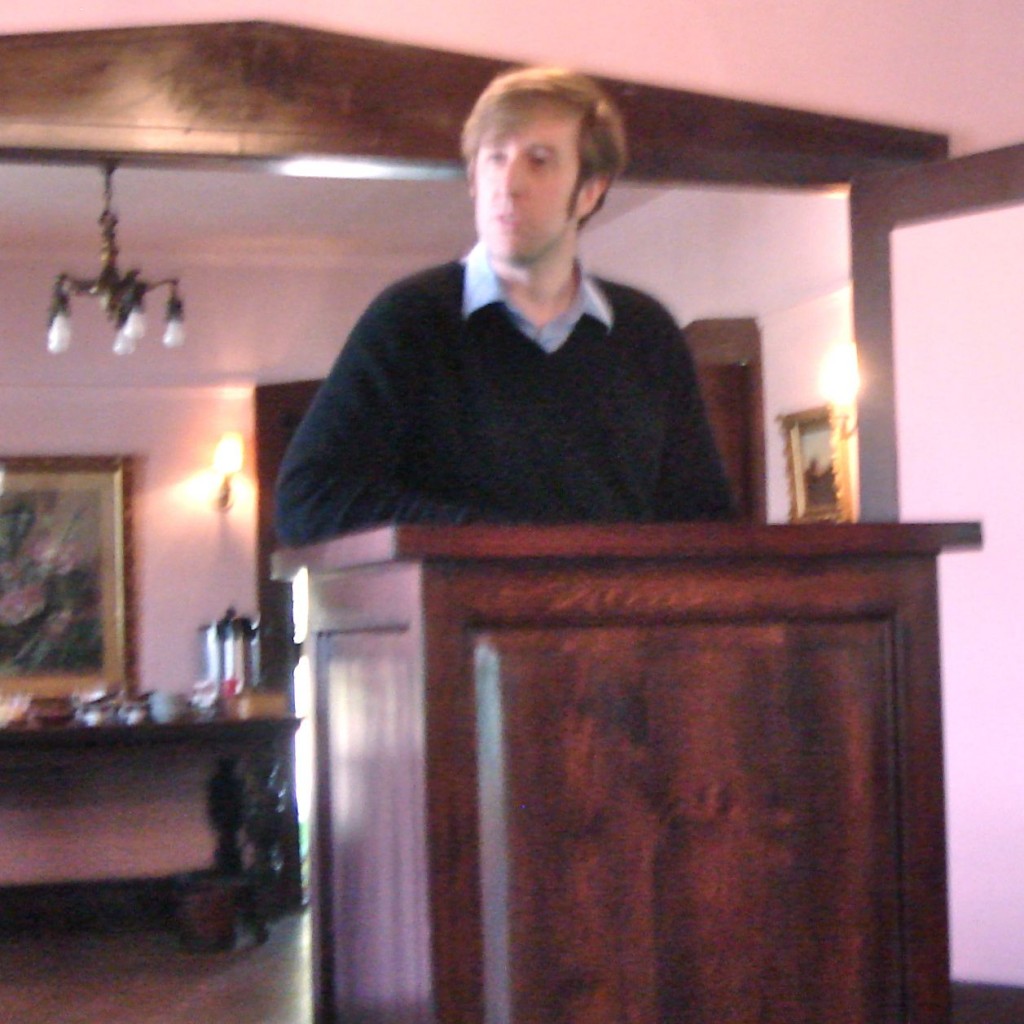
Standing at the podium. Associate Provost Wilkes, Dean Hayes, Vice President Akers, Ms. Washburn, faculty, staff, graduates, alumni, family, and friends–good afternoon. Today we celebrate our completion of the requirements for Pacific University’s Master of Fine Arts in Writing degree, and a milestone for each of us in our ongoing education as writers. This also marks the fifth year of this MFA program’s existence. And if any program has earned the right to act its age, this one has. If memory serves me, this involves spontaneous tantrums followed by graham cracker cookies and a nap. At least, that’s what I liked best about being five. It was also the age when I dictated my first poem to my kind and patient mother. It ran seven pages. And, although I have learned a lot since then, today I would like to be brief in simply reminding us all of some truths about this program, and about writing, we all already know–but might want to hear repeated.
Continue Reading “Pacific University MFA Commencement Student Speech” »

Poetry and Productivity

I would not have been able to complete an MFA in writing poetry while holding down a job as a technology executive had I not been a longtime practitioner of the GTD® methodology. In a recently released podcast, David Allen, my boss and the inventor of GTD, asked me about how the GTD concept of the ubiquitous capture tool relates to poetic inspiration. (That conversation begins around 16:56.) My process has evolved considerably in the past few years, from capturing phrases and lines whenever they came through my head to “assemble” later into a poem, to establishing a regular practice of opening up to the muse. This shift sees me capturing fewer individual lines in the moment, and focusing more on getting my head clear of work and personal responsibilities–by using GTD–so that when I do sit down to write, I can slip through the keyhole unencumbered into that poetic space.

The practice of capturing inspiration in the moment is nothing new to artists and writers. After the Ojai Poetry Fest Fundraiser, I had a stimulating conversation with a fellow writer who also happens to be a journalist. As our chat got interesting, he whipped out a pad and paper, seemingly on reflex, and began to take notes. He was “off duty” in the sense that he wasn’t taking notes for a news story–but it got me thinking that if one is, indeed, a student of life, there is no “off duty.” And a good student takes good notes about subjects that fascinate. The difference GTD makes, of course, is that it presents a systematic approach for what to do with those notes–including tracking any resulting commitments to oneself or others, and executing appropriate action and regular review in order to make one’s dreams more than just a scribble on a notepad.

So, in case I haven’t said it lately, thank you, David, for bringing this methodology into my life, helping me to bring appropriate focus and attention to the many different worlds I inhabit. The gift of being more present in my life is truly precious.

What I Learned in the Pacific University MFA in Writing Program

I have been asked to give the student speech in the upcoming MFA commencement ceremony. Needless to say, I am honored. I have been meditating on the experience of having completed this remarkable experience, now from a distance of about five months, and looking back over material from my time in the program. One piece that helps summarize some of what I learned from the MFA is the critical introduction to my graduate reading. And so, I am reprinting it here, on my site, for those who might be interested. I have enhanced the text with some hyperlinks. I gave this introduction, and then read poems from my thesis, on January 12th, 2009 at the Best Western Seaside Resort in Seaside, Oregon.

§

I came to my first residency, here in Seaside, Oregon, one year after the death of our infant son. That event brought me back to poetry by momentarily stripping away all other ambitions. Poetry alone got me out of bed some mornings, and helped me chart the difficult inner landscape of grief, often in the bleary pre-dawn hours before work. I sought out mentors to assist me in improving my poems, and, on the sage advice of my friend and mentor Joseph Millar, I enrolled in the low-residency Master of Fine Arts in Writing program at Pacific University.

Getting to that first residency was hard: it was the first time my wife and I had been apart since the birth and death of our son, my first time in the Northwest, and my first real writing conference. I knew no one other than Joe. But from my arrival by bus in the freezing dark, throughout the past two years, at every turn and in even the most minute details of my experience?I received confirmation, time and again, that I was in the right place.
Continue Reading “What I Learned in the Pacific University MFA in Writing Program” »

“What Are You Going to Do Now?”

Photo by Valerie Peake

As of Saturday, I am a graduate of the Pacific University MFA in Writing Program. Throughout that final residency, and especially at the banquet on Saturday, I lost count of how many times I was asked, “What are you going to do now?”

Some asked with such expectancy, I almost wondered if they thought I had been granted magic powers. I wanted to tell them about bounding over skyscrapers and shooting lasers from my eyes. But the real answer is far more simple: I am going to keep reading, writing, and conversing with other writers and thinkers about art.

Poetry has become a survival skill for me. And so, although I now find myself in the post-MFA, pre-first-book limbo, I will continue to keep reading and writing, with patience and determination, as though my well-being depended on it. Because, quite frankly, I have discovered a simple equation: the more I admit poetry into my life, the better my life becomes. So, perhaps I should answer instead that I plan to keep improving my life, one line at a time.

Open Thanks to the Pacific University MFA Program and All Who Sail in Her

In the movie, “The Savages,” Laura Linney’s character finds herself in a cheap motel outside of Niagara, having an affair with a married man she doesn’t really like. She sits bolt upright in bed, surveys the tacky decor and annoying middle-aged man beside her, and exclaims in pure bewilderment, “I have an MFA!”

It is funny only because it is true that having this particular combination of letters after one’s name is not an automatic pass into the love, understanding, and recognition we all crave. Being raised by public school teachers taught me that our society undervalues education in a way that can be seen as either comic or tragic–depending on how tired you feel at the end of the day–and that teaching is an act worth pouring your whole self into anyway. It is the same with art.

After the graduate readings at this residency, a new student remarked that they were struck by the profound sense of gratitude present in the hearts of each of us outgoing students. This program is suffused with a spirit of generosity. Faculty and students mix easily, talk honestly, and work hard not to take themselves too seriously. A visiting professor put it succinctly: “usually people are either really good or really nice–but here they are both.”

If the faculty were priests, and this were a church, we might predict that they will reap rewards for their generosity in heaven. But they are not priests, and this is not a church, and instead of taking confession or quoting answers from religious texts, they have instead stood by us, in their humility, and marveled at the beauty of the questions. It is a privilege just to be here, partaking of something that transcends commerce, and politics, and marketing-speak: the deep words. The ones that matter.

And the rewards these artists and teachers reap in this life, for having faced down the human condition in their own projects, and hung in there with us students through our likely all-too-familiar neuroses, insecurities, doubts, and hopes as we face down our own projects–is the knowledge, all too rarely expressed, that they have changed–not only our writing, but our writing lives–for the better.

If there were a better phrase in English to expres profound gratitude and respect, I would want to use it. But all I can think to say is “thank you”–to the faculty in all genres, to Dean Hayes for believing in this program, and to Shelley, and Tenley, and Colleen, and, formerly, Amber, and all the interns, past and present, who slog heroically behind the scenes to sustain this place where brilliance doesn’t require pretension, where sincerely never lacks toughness–where people set out, with their raincoats and tackle, in search of the deep words. It has been a privilege to travel with you in this vessel for a little while.


Popular Tags

Academia Academy Of American Poets Accessible Poetry Adam Zagajewski Aliso Street Bear Andrew Philip Anna Akhmatova Arroyo Arts Collective Artists' Union Gallery Art Therapy Avant Garde B.H. Fairchild Bart's Books Bell Arts Factory Blogging Code Poet Conservation Czesław Miłosz David Allen Day Fire Denise Levertov Dorianne Laux Facebook First Books Friday Lubina Galway Kinnell George Wallace Gerard Manley Hopkins Gregory Orr GTD Gwendolyn Alley Heart And Mind Henri Cole Hope Jackson Wheeler James Valentine Peake Japan Jawanza Dumisani John Ashbery John Keats Joseph Millar Kathleen Tyler Li-Young Lee London Los Angeles Louise Glück Low-Residency MFA Mark Doty Marriage Marvin Bell Mary Oliver Merlin Mann MFA Residency 1 MFA Residency 2 MFA Residency 3 MFA Residency 4 MFA Residency 5 Michael Wells Michelle Bitting Miranda Nature Negative Capability Ojai Ojai Poetry Festival Pacific University Passings Performance Poetry Phil Taggart Poetry In The Windows Polish Poetry Post-Postmodernism Ralph Waldo Emerson Rattle Read Write Poem Robert Hass Robert Pinsky Sandford Lyne Sandra Alcosser Sarah Maclay Seamus Heaney Social Networking Sonnets Spirituality Stanley Kunitz Stephen Booth Stephen Dunn Suzanne Lummis The Economy The Phoenix The World Stage Tree Bernstein Twitter Umberto Saba Wallace Stevens Why Poetry Zbigniew Herbert ZCE Zen Zoey's Cafe