
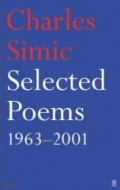
 Although Charles Simic was recently appointed Poet Laureate of the United States, that is not the kind of title I want to write about right now. In fact, there is so much to admire in his Selected Poems 1963-2003, that examining his choice of poem titles almost seems myopic. It has often been my experience, however, that honing in on a very specific element of craft can provide the necessary level of detail to illustrate more universal points.
The entire book, once I began reading it that way, became a lesson to me in how to write a good title. Titles are a kind of meta-line–a line that hovers from the very beginning over every other line of the poem, coloring it. It can be a key to understanding what’s going on in the poem, a one-stroke scene setup, or even perform double-duty as the first line of the poem. Simic rarely uses it in any of these ways.
Instead, his work explores the tension created by pitting a compelling title against a compelling poem. He seems well aware that this discrepancy can create a kind of titular anxiety, as the reader keeps referencing back to the title mentally through out the course of the poem, searching for a connection. What Simic gives us, however, is rarely a key or answer in the title, but more often something like a question that is actually more interesting than any neatly-tied-up statement.
To pick an example almost at random, the poem “Eyes Fastened With Pins” is a kind of sympathy-for-the-devil poem that follows the character Death through his thankless work night. The image of eyes fastened with pins never recurs. The poem in itself is satisfying, and the title in itself is satisfying. Together, something alchemical happens, as the farcical, almost fairy-tale romp through poor Death’s night shift collides with a gruesome image of death’s reality.
That is not to say all of the poems in this collection are exactly title-versus-poem. Like Ted Kooser, Simic often focuses intently on a single object. Yet unlike Kooser’s perfectly rendered Dutch miniature paintings of life, Simic plays rough with the lyric, at times almost smacking of a poet like Yusef Komunyakaa or Charles Bukowski. Simic is not afraid to be gritty or to leap boldly from line to line. But his leaps are always strangely contained and highly focused–the scope, although highly unusual, has its own kind of integrity. One way Simic achieves this–without totally sewing up the poem in a neat little package–is through the title.
Perhaps his most famous poem, “Stone,” for example, ends in the deeply surreal territory of staring at star charts on the inner walls of a stone. Another poem, “History Book,” does begin with a book, but ends up blurring the lines between the book and the present-tense reality as the pages fall into a river where “they” drown kittens. On this river a barge passes which “they named ‘Victory’ / From which a cripple waves.” Simic lets his poems skate like Robert Frost’s proverbial ice on a hot pan, and follows them carefully into more and more interesting territory as they dissolve. I almost wonder if, when they’re done, the poems name themselves.
These are titles that seem like they could only have been written after the poem, since what Simic focuses on in the poem by way of the title creates more interesting resonances, elevates the poem’s meaning, and opens, rather than closes, its themes. As a result, I found myself just today committing the rookie mistake of starting a poem with a thematic title, then quickly deleting it to allow the poem to take a different, more interesting turn. Thanks, Charles.