
“I have defined poetry as a ‘passionate pursuit of the Real.'”
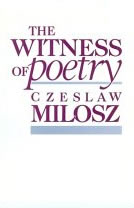 After finishing The Witness of Poetry, I found myself mourning the loss of a man I never met and mourning, most importantly, a mind and spirit so capable of characterizing the poetics of the past century–and thereby helping us understand a bit more of ourselves. Milosz seems to have defined the major dialectic forces at work in twentieth century poetry: language versus mimesis, classicism versus realism, science versus imagination, alienation versus “the human family” and West versus East. Owing to Poland’s unique, liminal situation in the interplay of so many of these forces throughout Europe, Milosz speaks with a kind of visceral authority about such broad characteristics of poetry in the past century.
He is not without bias in describing these dynamics. Fortunately for me, his biases run along similar veins to my own, so I frequently felt he was expressing many of my own latent thoughts and beliefs in a much more articulate and compelling way. Regarding science supplanting imagination as an organizing principle for our lives, he points out:
… science not only contributes to the perfecting of ever more lethal means of conducting war. It also penetrates the very fabric of our collective life, causing transformations whose range still eludes our comprehension. The pollution of the mind by certain images, those side effects of science, is analogous to the pollution of the natural surroundings by technology derived from the same science.
and much later, in relating to the horrors of the twentieth century–from the holocaust to the atomic bomb–he points out the stakes in such a dynamic are not merely aesthetic, but that, “It is possible that we are witnessing a kind of race between the lifegiving and the destructive activity of civilization’s bacteria, and that an unknown result awaits in the future. No computer will be able to calculate so many pros and cons–thus a poet with his intuition remains one strong, albeit uncertain, source of knowledge.”
Milosz points out that a defining characteristic of or time is not so much that life is harder now than in the past, but that we are more keenly aware of it en masse. He points out, “People have always suffered physical pain, died of starvation, lived as slaves. Yet all that was not common knowledge as it now is because of the shrinking of our planet and because of the mass media.” I have often related to poetry as a kind of antidote to the linguistic dissolution brought on by mass-media and technology, but Milosz goes further in framing poetry as a means to interpreting this new circumstance and therefore a kind of hope for humanity in the coming age:
Instead of presenting man through those traits that link him to higher forms of the evolutionary chain, other of his aspects will be stressed: the exceptionality, strangeness, and loneliness of that creature mysterious to itself, a being incessantly transcending its own limits. Humanity will increasingly be turning back to itself, increasingly contemplating its entire past, searching for a key to its own enigma, and penetrating, through empathy, [emphasis mine] the soul of bygone generations and of whole civilizations.
Milosz points out many other dynamics unique to modern poetics, though all of them are necessarily subordinate to this overarching struggle between science and imagination.
One other dialectic progresses between classicism–which Ellen Bryant Voigt and others might more recently call “lyricism”–and realism (also known as “formalism”–the rendering of the real). Milosz defines this struggle very clearly: “If I cross out a word and replace it with another, because in that way the line as a whole acquires more consciousness, I follow the practice of the classics. If, however, I cross out a word because it does not convey an observed detail, I lean toward realism.”
This struggle is further defined by somewhat newly introduced dimensions in contemporary poetry, including the move toward language poetry and its more traditional counterpoint–mimesis–the representation of the tangible in art. Of this, Milosz says, “Of course there are poets who only relate words to words, not to their models in things, but their artistic defeat [?!] indicates that they are breaking some sort of rule of poetry.” Though Milosz admits, “all attempts at enclosing the world in words are and will be futile,” he concludes from this, “let us respect the rules of the game as adopted by consensus and appropriate to a given historical period, and let us not advance a rook as if it were a knight. In other words, let us make use of conventions, aware that they are conventions and no more than that.”
By defining the trends, themes and limits of poetry, Milosz has given me a remarkably well articulated view into much of what I have already sensed: that poetry, in its capacity for empathy, in its ability to be so much more than an exercise from the neck up, can help us to understand our unique human condition in this particular time–and that all the the trends toward nihilism and deconstruction ultimately either must come to an end–or else we must follow them all the way down. That is, the choice between poison and medicine still rests with the “unacknowledged legislators”–as does the choice, with each word, line and verse–about which of the two will flow from our pens.