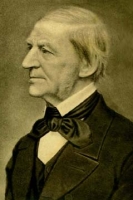
What’s It All About, Ralph?

Midway through the first semester of my MFA, I seem to have hit a slump. Not horrible–just not the zealous enthusiasm with which I seemed to attack the first few months. I have just been getting up early and sitting down in the chair to write anyway–even if no material I really liked seemed to be coming. As I said before, I am in this for the long haul. So, observing myself and learning to deal with all the ups and downs productively is part of the bigger lesson of this program for me.

Another tactic that sometimes helps me get things flowing again is to revisit an old favorite. Ralph Waldo Emerson is eminently quotable; his essay The Poet reads like a poem in itself. It is remarkable to read some of his thoughts and realize certain conditions in poetry are hardly new or unique. So, I pulled a few excerpts from this 1844 text that seem to be as relevant to contemporary poetry as they were to poetry back then.

Notwithstanding the necessity to be published, adequate expression is rare.

The sign and credentials of a poet are, that he announces that which no man foretold.

For, the experience of each new age requires a new confession, and the world seems always waiting for its poet.

Of course, the value of genius to us is in the veracity of its report. Talent may frolic and juggle; genius realizes and adds.

A beauty, not explicable, is dearer than a beauty which we can see to the end of.

The people fancy they hate poetry, and they are all poets and mystics!

The vocabulary of an omniscient man would embrace words and images excluded from polite conversation. What would be base, or even obscene, to the obscene, becomes illustrious, spoken in a new connexion of thought.

Every word was once a poem.


This insight, which expresses itself by what I called Imagination, is a very high sort of seeing, which does not come by study, but by the intellect being where and what it sees, by sharing the path, or circuit of things through forms, and so making them translucid to others.

So the poet’s habit of living should be set on a key so low and plain, that the common influences should delight him. His cheerfulness should be the gift of the sunlight; the air should suffice for his inspiration, and he should be tipsy with water.

But the quality of the imagination is to flow, and not to freeze.

We do not, with sufficient plainness, or sufficient profoundness, address ourselves to life, nor dare we chaunt our own times and social circumstance. If we filled the day with bravery, we should not shrink from celebrating it.

Art is the path of the creator to his work.

The poet pours out verses in every solitude. Most of the things he says are conventional, no doubt; but by and by he says something which is original and beautiful. That charms him. He would say nothing else but such things. In our way of talking we say, “That is yours, this is mine;” but the poet knows that it is not his; that it is as strange and beautiful to him as to you…

Doubt not, O poet, but persist. Say, “It is in me, and shall out.”

…wherever is danger, and awe, and love, there is Beauty, plenteous as rain, shed for thee, and though thou shouldest walk the world over, thou shalt not be ale to find a condition inopportune or ignoble.

16 Comments

  1. Michelle Bitting
    Posted April 3, 2007 at 7:36 pm | Permalink

    So wonderful, Robert. I love these and have never read them before. Thank you!
    And hang in there. Ebb and flow. Cycles.

    Damn them! Bless them!

    xoxo
    Mich

  2. Robert
    Posted April 3, 2007 at 10:18 pm | Permalink

    Hey, thanks for your encouragement, Michelle. Just kinda ironic to hit a dip in April of all months…

  3. Posted April 4, 2007 at 6:00 am | Permalink

    aprille is the cruellest month. keep the aith.

    best, howard

  4. Posted April 4, 2007 at 7:15 am | Permalink

    Ah….to miss a week and then stop by and see all these gems I have missed….mmmm what will my light fingered hands want to pick up next and steal away with….?

    I loved the poetic therapy post – the circular nature of poetry….though personally I tend to view it as a spiral….we or at least I tend to revisit themes but at each point along the spiral, the view is different…..and who cares if “therapeutic” poetry is great or not???

    Who are “they” that make this judgment – this decree?

    All poetry: ‘good’ ‘great’ ‘bad’ ‘mediocre’ changes the way one views the poem’s subject…..it is part and parcel of the nature of the art.

    Good writing to you…..your field is busily being plowed and seeded for a fresh crop of work…..April is planting time you know (from an old farm girl)…

    best regards
    rdg

  5. Robert
    Posted April 4, 2007 at 10:36 am | Permalink

    Thanks, RDG. I like the idea of a planting time, and that’s certainly been my experience. Sometimes when nothing seems to be flowing it can be due to not having taken in enough input. Then I’ll pick up a good book or listen to music or see a performance of some kind – and whadayaknow? Material – unrelated, usually, to the catalyst of what I’ve been taking in – appears.

  6. Robert
    Posted April 4, 2007 at 10:37 am | Permalink

    Thanks, now I know why they call it that! (And it isn’t just because of allergies.)

  7. Posted April 5, 2007 at 7:23 pm | Permalink

    Here, Bullet is quite a book. Not explicitly political, and all the more powerful for it, I think.

    Thanks for stopping by the blog. Keep checking throughout the month. Our goal is a new recommendation every week day. And we’d love to hear suggestions, as well.

  8. Robert
    Posted April 5, 2007 at 10:55 pm | Permalink

    I have come to the conclusion that the realm of the explicitly political is limited by all the usual defenses we have built up against political rhetoric. Poetry, by contrast, has a far greater and more insidious power to move us to into deeper, more complex and ultimately more human understanding of intense situations. Thanks for the recommendations and keep ‘em coming.

  9. Posted April 6, 2007 at 8:23 am | Permalink

    Getting back to root inspiration is a good start.

    Love the line “Notwithstanding the necessity to be published, adequate expression is rare.”

  10. Robert
    Posted April 6, 2007 at 8:29 am | Permalink

    And apparently it was still true over 150 years ago.

  11. Posted April 6, 2007 at 12:52 pm | Permalink

    Robert, thanks for visiting my blog! Emerson is one of my favorite poets too. You’ve got a nice blog going on here.

  12. Robert
    Posted April 6, 2007 at 2:59 pm | Permalink

    Thank you kindly. I like his essays best of all. :)

  13. Posted May 3, 2007 at 4:29 am | Permalink

    “The sign and credentials of a poet are, that he announces that which no man foretold.”

    “Of course, the value of genius to us is in the veracity of its report. Talent may frolic and juggle; genius realizes and adds.”

    Ah, I’d just as well hang it up. Way too frolicy, I am.

    It’s this kind of portentousness that made me stay away from writing poetry for 50 years or so.

    Hope your dry spell is over. I listen to a friend who doesn’t believe in writer’s block. If, she says, you aren’t writing, it’s because you have something else you need to do.

  14. Robert
    Posted May 3, 2007 at 8:45 am | Permalink

    Well, we all know genius frolics, too. And I agree, thinking too long and hard about genius can stop you pretty dead cold in your tracks.

    I like William Stafford’s advice for writer’s block (echoed by Marvin Bell): “lower your standards.” i.e. – just write! I doubt anyone ever penned genius without trudging through a lot of banality first.

  15. Posted May 3, 2007 at 10:37 am | Permalink

    Or possibly broaden your definition. Sometimes it just takes a lot of staring out the window to make a poem.

    I love William Stafford.

    Emerson I admire but he gets my back up.

  16. Robert
    Posted May 3, 2007 at 10:41 am | Permalink

    Hah! I learned a new phrase today. Count on me telling people to stop “getting my back up” all day long. :)

Post a Comment

Your email is never shared. Required fields are marked *

*
*


Popular Tags

Academia Academy Of American Poets Accessible Poetry Adam Zagajewski Aliso Street Bear Andrew Philip Anna Akhmatova Arroyo Arts Collective Artists' Union Gallery Art Therapy Avant Garde B.H. Fairchild Bart's Books Bell Arts Factory Blogging Code Poet Conservation Czesław Miłosz David Allen Day Fire Denise Levertov Dorianne Laux Facebook First Books Friday Lubina Galway Kinnell George Wallace Gerard Manley Hopkins Gregory Orr GTD Gwendolyn Alley Heart And Mind Henri Cole Hope Jackson Wheeler James Valentine Peake Japan Jawanza Dumisani John Ashbery John Keats Joseph Millar Kathleen Tyler Li-Young Lee London Los Angeles Louise Glück Low-Residency MFA Mark Doty Marriage Marvin Bell Mary Oliver Merlin Mann MFA Residency 1 MFA Residency 2 MFA Residency 3 MFA Residency 4 MFA Residency 5 Michael Wells Michelle Bitting Miranda Nature Negative Capability Ojai Ojai Poetry Festival Pacific University Passings Performance Poetry Phil Taggart Poetry In The Windows Polish Poetry Post-Postmodernism Ralph Waldo Emerson Rattle Read Write Poem Robert Hass Robert Pinsky Sandford Lyne Sandra Alcosser Sarah Maclay Seamus Heaney Social Networking Sonnets Spirituality Stanley Kunitz Stephen Booth Stephen Dunn Suzanne Lummis The Economy The Phoenix The World Stage Tree Bernstein Twitter Umberto Saba Wallace Stevens Why Poetry Zbigniew Herbert ZCE Zen Zoey's Cafe