Tag Archives: Ojai

A Bird Black as the Sun

I came home tonight to a lovely surprise: my contributor’s copy of A Bird Black as the Sun: California Poets on Crows & Ravens (Green Poet Press, 2011). If being a poet in California was like being in High School, this anthology would be my yearbook. The table of contents reads like a trip down memory lane.

Who knew these dark muses could set the quills of so many fine poet-friends a-quiver? I know what I will be reading on the tube for the rest of this week–poems like Jackson Wheeler‘s “Crow Sings Jazz” and a promising-sounding one by Paul Fericano, ever obsessed with The Three Stooges, entitled “Curly Howard Misreads Edgar Allen Poe.”

My own poem, “Shelf Road, Ojai” (originally titled “Crow”) qualified me first for an honourable mention in the Atlantic Monthly Student Poetry Competition, then as a runner-up in the Indiana Review Poetry Prize–but has never actually been published before. Re-reading it brings me back to the eponymous trail in a Shangri-La now some six thousand miles away. Perhaps all along these messages-in-a-bottle I call poems were only ever meant to return to me on the shores of a different island, to remind me of who I was, and who was with me, everywhere that I have been.

The anthology is now available at local bookstores or on Amazon.com.

Two Poems in Aperçus Quarterly Online

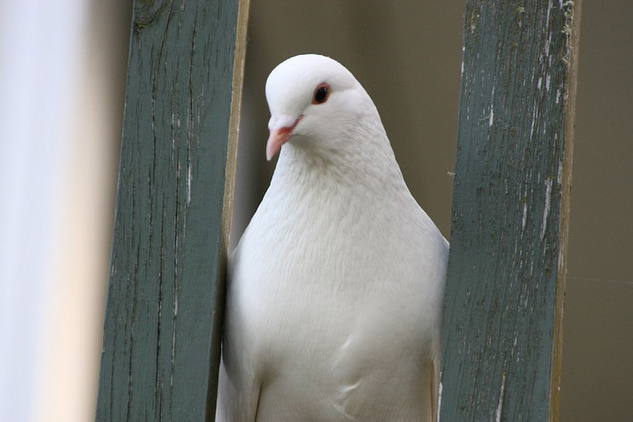
Photo by James Brunskill

I am pleased to have two poems appear in the inaugural issue of Aperçus Quarterly. The poetry section features fine poems by colleagues and mentors such as Boyd W. Benson, Cameron Scott, Marvin Bell, and Peter Sears. The collection is  a manageable size, and each poem is worth a read. The images beneath each poem are also striking, evocative, and well-chosen to compliment the written piece.

I wrote the poem “White Pigeons” while still in Ojai. There is a coop nearby my parents’ house. Re-reading the poem from my office in Soho makes me homesick for a place that now seems so far away as to almost have been imagined. It is, for me, a pleasant kind of haunting. Enjoy the poems.

London Calling

Valerie and I are planning to move to London, to be close to her family and to start a new chapter in our life together. My application for a settlement visa is at the British Consulate. After it arrives I will find a job. If you know of any dynamic, world-bettering companies that need a Chief Technology Officer with a mind for scalable web architecture and the soul of a poet, please let me know.

Although the timeline is not yet clear for our move, we decided that it was important to reach out now to our community of friends for support. Also, this gives us the opportunity to start to say “goodbye” to so many wonderful people on this continent.

We are especially fond of Ojai, the small town in California we have called home for the past several years. The word “ojai” means “nest” in the language of the Chumash Indians who first inhabited this area. Indeed, it has been a nest for us in which to be nurtured and grow strong. Now we fledge.
Continue reading

Poem in The Ojai Bubble

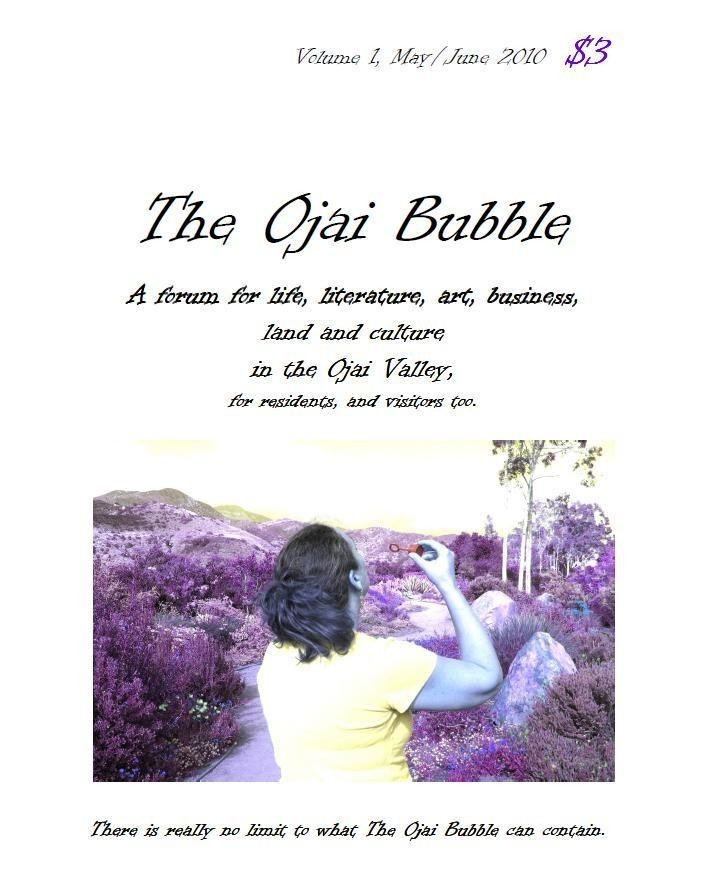
I was pleased to receive contributors’ copies today of a promising new local publication, The Ojai Bubble. My poem , “All the Westerners in the Japanese Restaurant,” is artfully laid out on the inside back cover. The magazine overall–conceived, created, and printed in Ojai–contains a mix of thoughtful editorials, photos, and poems as eclectic and delightful as the by-turns-quaint-and-sassy small town I am proud to call home. Kudos to poet and journalist Nancy Gross for expanding in this direction, bringing new and familiar voices together under one shimmering cover.

This inaugural issue is available now at select locations throughout Ojai.

An Unexpected Dedication

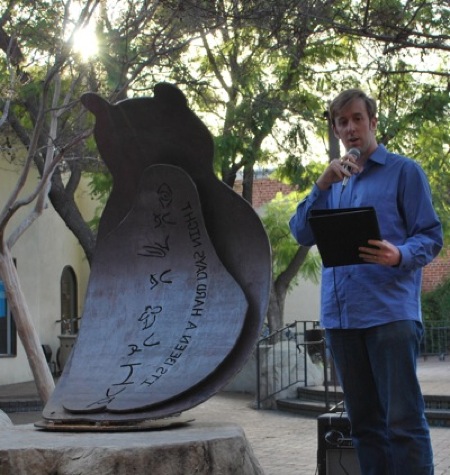
Robert Peake reads a poem next to "Elliot" the bear

Photo by Randy Graham

I broke away from work to attend the dedication ceremony for my neighbor Mark Benkert’s new memorial sculpture to the Aliso Street Bear (a.k.a “Elliot”). In introducing me to read the poem I wrote dedicated to the bear, Mark also mentioned something remarkable about the process of sculpting the memorial.

For both Mark and I, the loss of the bear resonated deeply with the loss of our sons. As Mark was inscribing the letters “J” and “B”, the initials of his son, Jonah Benkert, the “B” also read much like a “P”–and he mentioned that “J.P.” reminded him of our own son, James Peake. Needless to say that by the time I took the microphone, I was nearly unable to speak.

Yet I managed to read my poem, honoring the bear, our sons, our community. The rest of the dedication meant a lot to me–from written poems and prose pieces, to impromptu verbal tributes, a song, and drumming. It was also a moment of catharsis for our community, coming together once more to honor all that the bear brought to us.

To learn more about how to promote the peaceful coexistence of humans and animals in the Ojai Valley, please visit the Ojai Wildlife League website.

“Climb the Pine” to Remember the Bear

I am not the only one for whom the bear seems to have left an indelible imprint. Each morning this week, when I step outside my door to go to to work, I see the silhouette of a bear in the pine tree just across the street. It looks just like him. But it is not him. It is a 70-pound metal sculpture created by my neighbor, Mark Benkert, in memoriam. The following video tells the story of how it got there.

To learn more about how to promote the peaceful coexistence of humans and animals in the Ojai Valley, please visit the Ojai Wildlife League website.

To the Bear in a Neighbor’s Tree (A Poem)

I never post new poems on my website. But this piece came through me this morning, and I want to offer it up to our grieving community.

To the Bear in a Neighbor’s Tree

Audio clip: Adobe Flash Player (version 9 or above) is required to play this audio clip. Download the latest version here. You also need to have JavaScript enabled in your browser.

How quickly we become accustomed to the light,
blinking through discomfort, standing upright,
when our claws break, we fashion tools, use
them, and then just as easily put them down.

We discover clumps of hair on the ground,
and see our lack of fur as a great improvement,
stamping and shivering, we like a cold wind!
When our night vision fades, we stumble a dance.

Now, we have lost you too, primeval cousin,
lost the instinct that might have guided us
in shooing you back where you came from.
We can no longer smell what is on the wind.

You sat all day in a tree, learning our gestures.
You waved at the crowds and considered making a speech.
When you became too much like us, we brought you down,
and hauled your massive blackness into the night.

The truth is that we lost you long ago, long before
our friends loaded up their guns. Look how far
we have come! Our fingers fit the triggers.
And still we remember not to look in an animal’s eyes.

I looked, and became frozen on my couch.
I blinked into the sunlight, and you were gone.
The black spot in the tree is no longer you.
It is the place that you have burned into my mind.

To learn more about how to promote the peaceful coexistence of humans and animals in the Ojai Valley, please visit the Ojai Wildlife League website.

The Bear

When my English wife first came to this country, she was eager see North American wildlife. “I want to see a raccoon,” she said. Soon after, we found ourselves in Yosemite, watching a family of raccoons collecting and munching stray Cheetos, orange paws aglow in the moonlight. “I want to see a sea otter.” At the Monterrey Bay Aquarium, we watched sea otters float on their backs like canoes and smash open abalone on the rocks. “I want to see a bear!” she grinned.

I paused, remembering my father’s story of having been nose-to-nose with a grizzly bear, separated only by mosquito netting–the story he told on Boy Scout camp outs that kept us awake in our tents all night. “No,” I replied, “No, honey, you don’t. You want to see a bear in a photograph. You want to see a bear on a nature documentary. You don’t ever want to see a real, live bear up close.”

The Bear

Photo by Erin Ellwood

When I heard our neighbor exclaim, “Call animal control!” late Friday night, I assumed raccoons had found their trash. I rolled over and went back to sleep. In the morning, we discovered several police vehicles parked on our street, and a crowd gathering on our front lawn. In the night, a several-hundred-pound Black Bear had scaled our neighbor’s back fence, bounded down the gravel footpath between our houses and, confused by the people and lights, followed his instincts up a large pine tree across the street.

People came to take pictures. People brought their small children, and hoisted them up on their shoulders to get a better view. Eventually, the police cordoned off the street, and still people gathered along the line of yellow police tape to catch a glimpse of the bear. From our living room couch, the cat and I sat and watched him–napping on a branch, shifting his considerable weight, hugging the trunk of the tree. At one point, he seemed to be waving, fanning the air with paws the size of my head. I got to watch the bear, closely and safely, for a long time. And I fell in love.

Continue reading

Broken Word at the Farmer and the Cook

I had the pleasure of reading a few poems tonight alongside Judy Oberlander, Joan Nicholson, Steve Sprinkel, and Johnny Fonteyn in the front patio of The Farmer and The Cook. Despite noise from an occasional bus or rap-spewing low rider, the air was deliciously warm, and the stage was backed by swaying trees. Overcoming initial hesitation, I read a poem featuring sushi at this charming all-vegetarian restaurant. Nobody threw potatoes.

On the contrary, the atmosphere was friendly and casual, aided in part by the well-received happy hour offer of one dollar off organic beer and wine. The patio was packed, and chatty at intermission. P. Lyn Middleton did an excellent job emceeing the evening, with just the right blend of structure and southern grace. This was the second in what appears to be a very promising new series of readings, and the perfect way to spend a summer evening in Ojai.

Featured Poet at the Village Jester Pub in Ojai

PubI had a great time reading at The Village Jester Restaurant & Pub tonight. We live all of three blocks away, so I grabbed a music stand and a handful of poems, and Val and I walked there through a balmy May night. In addition to being a great hangout and gathering place, The Jester also pours a strong Rose’s Lime and soda.

The open mic was remarkable for the raw, authentic nature of each piece. And, special bonus, my father read a poem as well–something he hadn’t done since he was nineteen, and read at an open mic prior to the feature of a different Robert–Robert Frost.

Many thanks to Tree Bernstein and The Jester for bringing good people to a good spot to share some poems. I can’t think of a better way to start the week.

Open Thanks

My friend and colleague Kelly Forrister (née O’Brien) stopped by this evening to hand me an autographed copy of Seamus Heaney’s New Selected Poems: 1966-1987. She studied with him and several others on a summer course at Trinity College, Dublin, and had pints with him after class. This was just after his appointment at Oxford, and before his Nobel Prize. I am touched that she would give me something so personally meaningful.

Funnily enough, although we only live a few pretty blocks apart in the sleepy idyll that is Ojai, she found out about my rekindled interest in Heaney from this website. Who says blogging doesn’t have its rewards? In the end I have only to say: thank you, Kelly. I will use it well.

Emulation, Originality, and the Writing Tradition

“A writer is a reader moved to emulation”

–Saul Bellow

I have been preparing notes for my upcoming talk on “Emulation, Originality, And The Writing Tradition” at the Ojai Center For The Arts. There is no better place than London to have spent time thinking about the English literary tradition. In this talk I intend to use concrete examples from my own relationship to the writing life, including poems and anecdotes, to show how emulation–as defined by a desire to imitate and transcend the spirit and tactical successes of works one admires–can actually enhance originality.

So many poets are concerned about losing their voice, and so many poets and non-poets hold the misbelief that art can exist in a vacuum–or that inspiration strikes best in a sealed cave, cut off from tradition. My hope is to inspire the audience into participating in the continuity of literary tradition through reading widely and responding genuinely to our rich heritage of literary arts.