Category Archives: Books

Votes of Confidence

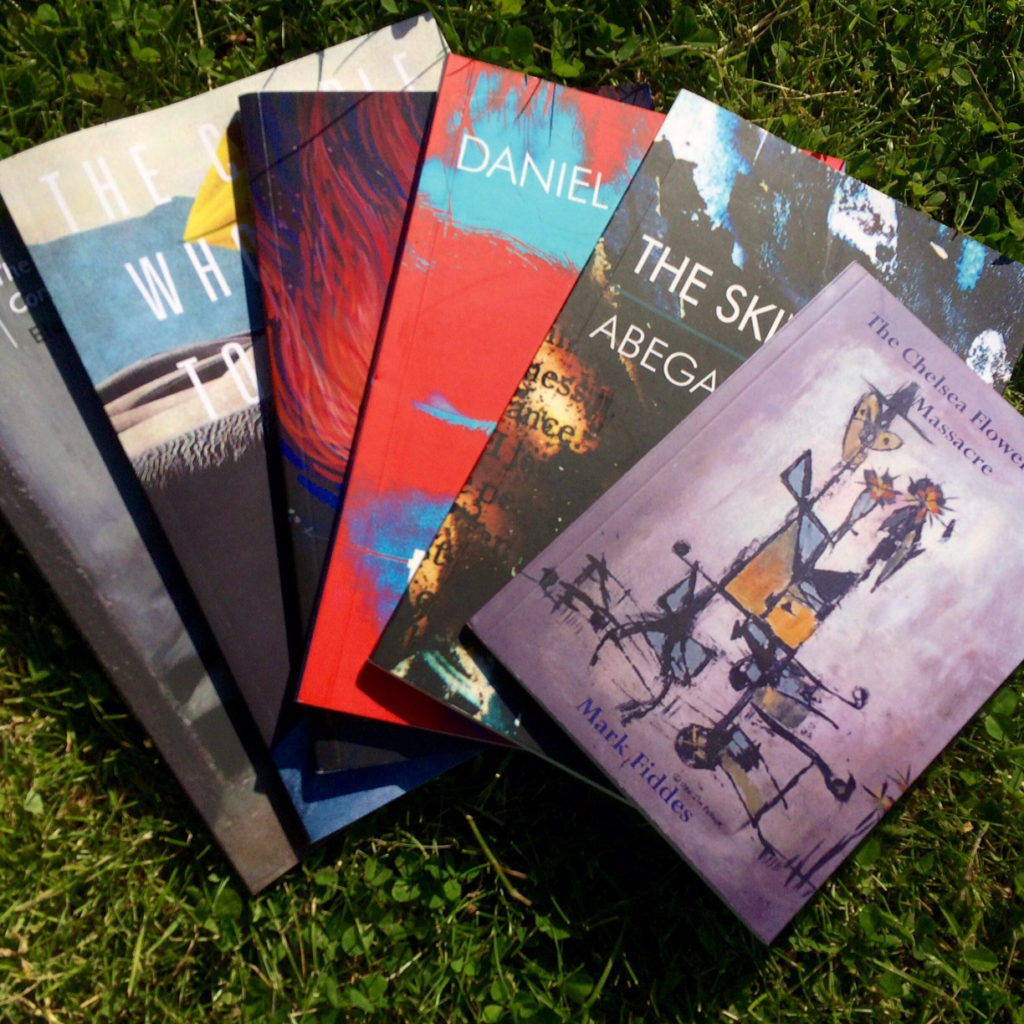
After I finalized the manuscript for Human Shade, my debut short collection appearing in the Lost Horse Press New Poets Series, I gave friends, family, and co-workers the opportunity to pre-order the book. The response has been unexpectedly wonderful.

Each order that has come in so far has felt like a small vote of confidence in my work. Collectively, they represent a substantial community of encouragement and support. By taking and fulfilling these orders myself, I feel personally connected to readers. I can also see where the books are going, as shown on the following map:


(Drag to move; double-click to zoom.)

The first two boxes of books are scheduled to land on my doorstep on Thursday, and nearly all of them already have homes. Almost as soon as they land, I will need to request more books from the publisher in time for my readings in March.

This, to me, is the best the Internet can offer–a sense of personal and meaningful connection to a global community of support. Prior to this experience, if you had asked me to name fifty to a hundred people who would be willing to pay good money to make extra sure they got a signed copy of my book, I’d be hard pressed to name them. Now I know who you are.

I look forward to shipping out books this weekend.

Return of the Fist by Amy Lingafelter

Return of the Fist is the third short book in the third volume of the Lost Horse Press New Poets Series. Illinois-born Lingafelter flirts with deeper human concerns through surrealism, holding up, as she writes in “Holoblastic,” “a mirror / in the bathroom of the party.” The speaker goes on in this poem to admonish those on “the road to Recovery” through cleverly spring-loaded syntax that “you’ll never always be wanting / just one thing.”

Indeed, Lingafelter never gives the reader “just one thing.” It is from “Days of Grace” that the theme of the title emerges, through an extended metaphor comparing ear-nibbling “Mike T.” to the speaker’s own animalism, indecision, and inability to avoid returning to “the fist.”

This signature combination of absurdity and pathos, dealt like a one-two punch, culminates succinctly in “My Cousin,” where we learn:

…My cousin was kicked in the face by a horse,
pregnant, indoctrinated, working at a Dollar Store,
in the Air Force, naked behind a shrub,
pregnant, married for three weeks,
when all of a sudden, she evaporated into a POOF! of tiny spores
she rode the wind southeast,
searching for the right conditions under a tree, a large stone,
to mold on, groove on, get kicked in the face by a horse,
pregnant, promoted and given a key,
felt up by a doctor, pregnant,…

The two most startling elements of this poem, that the cousin is “pregnant” and “kicked in the face by a horse,” recur and interweave through a series of believable and unbelievable “facts,” juxtaposing the plausible and tragic (“felt up by a doctor”) with the equally-shocking, but clearly surreal (“she evaporated into a POOF! of tiny spores.”)
Continue reading

Death Song for Africa by Victor Camillo

Death Song for Africa is the third short book in the second volume of the Lost Horse Press New Poets Series. Connecticut-born Camillo’s poems are set in the landscape of the American Midwest, with reference to many countries, cultures, and religions.

The opening poem, “Bar Mitzvah for Seth,” reminds me of the celebrated Israeli poet Yehuda Amichai in its ability to confront the weight of history through striking imagery:

My son does not know
That he is the oak outside the window
Whose leaves are blowing away,
That he is a raindrop,
A word someone might say,
That his name is not written
In any of the prayer books that his visitors
Pick up in the outside hall,
That the Jewish dead,
Lost on their way to Israel,
Are burrowing into the Synagogue walls.

Many of the poems in this collection are haunted by the past. The dead, skulls, and the skeletal recur, as does blood. In “The Monster of the Dead,” the speaker tells us, “At night the water in the tire tracks beside my house / Becomes my blood.” And in “The Disappeared,” the speaker admonishes himself, “I should remember that the pencil I put on an empty page / Is a thin finger of some anonymous starvation.”

Other poems are haunted by the present. Continue reading

Liminal: A Life of Cleavage by Lisa Galloway

Liminal: A Life of Cleavage is the third short book in the first volume of the Lost Horse Press New Poets Series. Indiana-raised, now Portland-Oregon-based Lisa Galloway believes that “poetry should be a shock to the senses, it should evoke something and it should leave you with something.” In poems about love, sex, drugs, and family dynamics, these poems look you straight in the eye.

The collection involves frank depictions of lesbian culture and sexuality. It is also laced with double entendres. The title itself depicts an irreverent attitude–since one who feels cleaved could be said to reside in a liminal space, neither fully inhabiting one part or the other; and also “a life of cleavage” carries all the intended sexual humor of a low-laced Renaissance Fair bodice. Throughout this collection, Galloway turns philosophy into wit, and draws the deeper philosophy and pathos out of seemingly glib word-play.

In “I Want to Shake You,” the speaker addresses a cared-for bereaved, and the futility of getting through to her:

…like you
are in Plato’s cave chained,
you can’t turn around to see
that the road does go on,
and there is more to life than shadows,
even though the buildings
are all wrong angles.

Sometimes you stay
because you’re still searching
for the words that should have been
her suicide note.

Continue reading

Last Night’s Fire… by Jesse S. Fourmy

Last Night’s Fire and the Dwindling Embers of Evolution is the second short book in the fourth volume of the Lost Horse Press New Poets Series. Drug Enforcement Agency Special Agent Jesse Fourmy writes from his “government outpost on the Big Island [of Hawaii].”

These poems fuse a casual tone with a quirky outlook,  a deeper pathos always just beneath the surface. If Keanu Reeves could write poetry like William Carlos Williams, the result might read a bit like Jesse Fourmy. I assure you there is nothing quite like it.

Take the following passage near the end of “White,” for example:

…only one of us lost our virginity that year
and it wasn’t me and I wouldn’t for a few more
because I was scared and shy and disguised myself
valedictorian of wise-crackers and smart-asses
class clown performing in a room full of strangers
who had cars of their own and sped past me on their way
home or work depending on the season or the hour
and this was life in the middle eighties in Arizona
and don’t let me fool you, bud, it wasn’t that bad
if you’d been in prison or paid regular visits to
torture chambers the house I grew up in felt like
home…

Fourmy’s poems often take the form of a single long stanza, driving forward uninterrupted, while building on past references, down to an unexpected end. The two dream sequence poems, for example, end as “People rummage your pockets. Steal your things. / One your money. Another a photo of your wife.” and as “you plug into your radio and a woman’s voice / you’ve never heard doesn’t laugh or call your name.”

My favorite poem of the collection, “The Speed of Light,” which is broken into several stanzas, ends a “confession” to a former science teacher reflecting on the “cupric” smell of urine, “a warmth of fatted cows staring oddly at motorists for miles.” Urination is a recurring theme in this collection, “pissing” outside under “the weight of the stars,” relieving oneself as a substitute teacher between classes in the science room sink, or as a three-year-old in a caretaker’s lap.

This is a collection that reaches ad astra per aspera, neither smoothing over the rough patches nor losing sight of the starlight.

Last Night’s Fire and the Dwindling Embers of Evolution is available in New Poets | Short Books Volume IV from Lost Horse Press. Read more reviews from the Lost Horse Press New Poets series.

The Woman Who Cries Speaks by Patricia Staton

The Woman Who Cries Speaks is the second short book in the second volume of the Lost Horse Press New Poets Series. Patricia Staton‘s long, irregular lines snake down the page in all but the two prose poems in this collection. These are poems composed, like a scrapbook, of memory fragments. But they are also punctuated by a direct and declamatory voice, as in the end of “We Have Our Rats”, where the speaker exclaims, after a by turns disgusting and whimsical meditation on rats, “Hey! Listen up! Nobody here’s mourning rats. / I’m shivering, frowzy, awake, but no.”

This direct, at times outlandish voice, more delicate snatches of memory, and the ragged-line form culminate in the long poem “from: Mother”, which begins:

Every night the dry stars, the tops of trees,
the moon I’m trying to paint a new face on.
Every night at my feet the tomb that holds
what needs to be aired. I am left to leaf through
everything that mattered
that you could never speak of.

It continues in this sonorous way, rich with image fragments, until the speaker interrupts herself with, “This is hard. In this version I don’t know if I hope you hear me or not.” And later: “Someone said it isn’t that the dead don’t listen / it’s that they no longer care.” In this way delicate memory is interrupted and confronted by a second self.

The syntax in these pieces often amplifies this scherzo. For example, Staton dangles prepositions to great effect:
Continue reading

The Owl’s Ears by Boyd W. Benson

The Owl’s Ears is the second short book in the first volume of the Lost Horse Press New Poets Series. Benson begins the poem “It Was Too Late” with the simultaneously nutty and philosophical line: “I never saw myself coming.” From here, this poem takes on some of the beautiful sorrow of a poet like Larry Levis, as “local dogs / lay down with the sound of my name.” Later:

I did not see myself in others,
the boozy young army reservists
or the old women of silken bones.
I could not remember dreams.

Yet it is precisely through a dreamlike world that Benson guides us in this collection. He introduces us to strange characters like “The Silent Comedians” and “The Opener of Doors.” In his realm, Magritte-like surrealism, full of portals and hats, can be married to more deeply philosophical concerns (one poem is entitled “Socrates”). Led on by a voice as confident as our own mind, we the dreamers never question events like those that begin the poem “After the War”:

Someone made a hat and tossed it in the air,
a new motto waved a flag, and the shadows
spoke freely without us. It was a dictum
could make a heart shine like a small star
and a mouth feel the song in it.
Then someone threw a parade and marched
the bones home, regiment by regiment.

Continue reading

Fugue by Emily Bobo

Fugue is the first short book in the third volume of the Lost Horse Press New Poets Series.  Bobo was born in Kansas and now lives in Indiana with her musician husband. Herself a “recovering musician,” Bobo writes about an ex-pianist’s relationship to her instrument, citing two definitions of “fugue” on the cover page–first, the obvious musical definition involving multiple voices playing a contrapuntal theme; second, the psychiatric definition involving a psychological flight from circumstances, manifesting like amnesia.

My beloved wife is also a recovering pianist. An injury in her mid-thirties brought her successful concert career in Europe to an abrupt halt. I know intimately that, whether the circumstances of prevention are physical or psychological, dedicating one’s life to the difficult task of becoming a successful pianist, then having to stop, can surface painful memories and profound questions. Bobo approaches these with an almost archaeological curiosity, interspersed with biblical grandeur, and scraps of dear-diary-like confession.
Continue reading

The Heights by Tim Krcmarik

The Heights is the first short book in the second volume of the Lost Horse Press New Poets Series. Chicago-born Krcmarik, now a Texas fire fighter, mixes a cocktail of bravado and tenderness, literature and low-brow dialog. The speaker in the opening poem, “Soulmobile” tells us, “I like my Shakespeare mixed up with my Dante / the same way I like hot sauce dumped over my fried / ham steaks and scrambled eggs.” Later:

[...] I see this dog carstruck and bowled
into the roadside briars. His world begins to gray,
Light leaks out from the busted gaskets around
his eyes. Blood runs from his ears and his rectum.
I sit and hold him. The ants start eating us. Start
fattening up. They’re smart, but I have a truck,
so I run him over and burn their colony with
siphoned gasoline. [...]

God and fire recur throughout this collection, sometimes colliding as in the poem “Beloved,” a street-tough retelling of Adam and Eve with the surrealism of a Hieronymus Bosch painting. Continue reading

Acts of Contrition by Gwendolyn Cash

Acts of Contrition is the first short book in the first volume of the Lost Horse Press New Poets Series. “Today I’m going to lie about everything” begins Cash in the opening prose poem, “Lies.” The poem, like the whole collection, is actually stark and startling for its honesty, taking up Emily Dickinson’s advice to “tell all the truth but tell it slant.” For example, under the guise of enumerating lies, the speaker tells us:

I’m going to lie about how many times I let a man break my heart, how many times I looked in his eyes hoping for a piece of myself, and finding nothing, crawled into the animal warmth of his body, gambling against the time when there was nothing left to take or give. I’m going to lie about every time I went back and begged him to break me again.

This gritty truth-telling reaches its apex in the title poem, a ten-part long poem sequence where a daughter who feels herself inadequate addresses her abusive mother. The raw imagery, bold address, and dreamlike progression are reminiscent of Galway Kinnell’s early masterwork, The Book of Nightmares.
Continue reading

Short Book Forthcoming

[UPDATE: books are now available for sale.]

I just received the good news from series editor Marvin Bell that a collection of my poems will appear in the Lost Horse Press New Poets | Short Books Series, Volume V. Like the previous four volumes, this book will again bring together what are essentially three chapbooks (also called “pamphlets” in the UK) by three up-and-coming poets, all under one cover. The format of this series was inspired by Scribner’s “Poets of Today” series, edited by John Hall Wheelock, which debuted poets such as James Dickey. According to Bell:

The series will introduce poetry that presses the boundaries of language–the sociopolitical, the surreal, the nutty, the extreme, good free verse, and good formalist verse. We prefer lively nonsense to earnest meaninglessness. We do not care for theory-based experiments. Manuscripts will be made up of poems someone can hate and someone can love. Middle-of-the-road doesn’t interest. Anyone who reads the work, whether they love or hate it, should immediately say to herself, ‘Well, this is different.’

I am thrilled to be part of this series, which has already brought so many gritty, gutsy, sharp-as-tacks new American poets to light. The book is scheduled for publication in February 2011.

Poetry as Anthropology

We come in peace

I curled open the first pages of The Penguin Book of Contemporary British Poetry expecting to find an introduction like so many others to this type of book–full of generic exuberance for the editors’ generation. Instead, Blake Morrison and Andrew Motion (I assume the introduction was written by both) made the following observations in 1982, which still seem directionally interesting nearly thirty years on. They wrote that, “…as a way of making the familiar strange again, they [contemporary British poets] have exchanged the received idea of poet as the-person-next-door, or knowing insider, for the attitude of the anthropologist or alien invader or remembering exile.”

While the enthusiasm for Martian persona poetry by Craig Raine and Christopher Reid seems like a hyperbolic extension of this principle, the idea of poet-as-anthropologist I find not only fascinating, but useful in understanding contemporary poetry on both sides of the Atlantic. In particular, it seems to answer “what comes next?” after a glut of confessional writing. They address this, as well, directly:

This development has been antipathetic to the production of a candidly personal poetry. Most of the devices developed by young poets are designed to emphasize the gap between themselves and their subjects. The poets are–to borrow a phrase from Seamus Heaney’s ‘Exposure’–’inner emigrés’: not inhabitants of their own live so much as intrigued observers, not victims but onlookers, not poets working in a confessional white heat but dramatists and story-tellers.

Continue reading