Articles in the Category of Spirituality

The Highest Good

“There are two ways to live your life: one is as though nothing is a miracle, the other is as though everything is a miracle.”

-Albert Einstein

I recently met someone who is striving to further the idea of the technological singularity. He used an interesting metaphor to describe his work. He asserted that, given three wishes from a genie, the best possible first wish would be to wish for more wishes. Striving to eliminate disease, aging, and death, he said, was a bit like “wishing for more wishes” from life.

It was a clever way to describe the hope some hold for technology’s seemingly unchecked advance against death. But something about the metaphor did not seem right to me. In the end, I came to the conclusion that the best first wish would not actually be to wish for more wishes, but to wish instead to know the summum bonum–the highest possible good–for the use of the remaining wishes.

The next wish might, indeed, be for more wishes, or for the strength to carry through on that final summum bonum wish–or for something else entirely. Because I have not actually been granted this first wish to know that highest good, I can not know what would come next. But I do know that unchecked individual omnipotence, in the form of endless wishes, would alter not only the consciousness, but quite possibly the physiology of the wisher. In the face of limitless opportunity, the brain chemistry could change–causing one to become paralyzed by choice, go mad with power, or drop dead from a heart attack.
Continue Reading “The Highest Good” »

The Power of Not Knowing

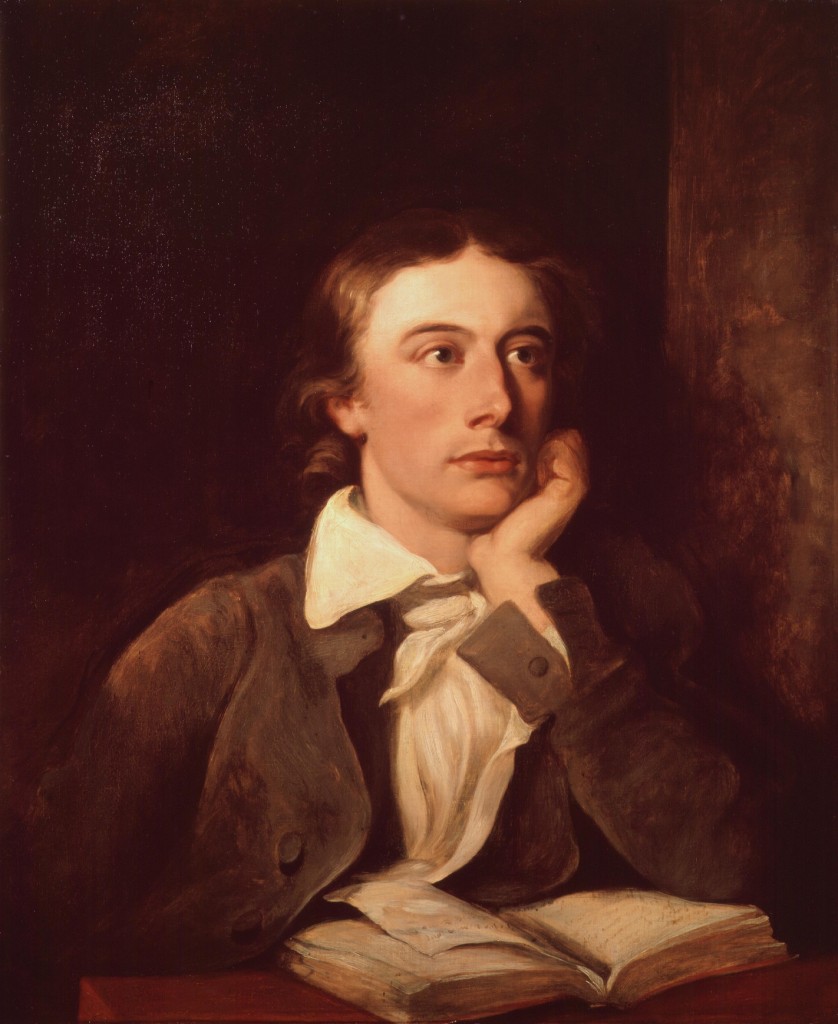
“I am certain of nothing but the holiness of the heart’s affections, and the truth of imagination.”

-John Keats

In my life, my writing, and my appreciation of literature, I strive for awareness and understanding. I have done so in my life through the disciplines of theology and philosophy, in my writing through the tutelage of other writers, and in my appreciation of literature through the study of literary criticism. I have engaged each discipline, formally and informally, throughout my life. And so, I am myself one common denominator among these fields.

That said, I also recognize a dynamic interrelationship: my life influences my writing, and my writing influences my appreciation of the written word; conversely, my appreciation of the written word influences my writing, and my writing influences my life. With this interconnection in mind, I am also beginning to discover, and attempt to articulate, an important principle held in common among the three.

It stems from a phrase coined by an eighteenth-century English poet named John Keats, who said:

…at once it struck me, what quality went to form a Man of Achievement especially in literature & which Shakespeare possessed so enormously–I mean Negative Capability, that is when man is capable of being in uncertainties, Mysteries, doubts without any irritable reaching after fact & reason.

Continue Reading “The Power of Not Knowing” »

Christian Wiman’s Riven Verse

“There are keener griefs than God. / They come quietly, and in plain daylight, / Leaving us with nothing, and the means to feel it.”

-Christian Wiman, “This Mind of Dying”

Though this year’s edition of Poetry International is packed with poetic delights, the portfolio section on Christian Wiman knocked me out. Though the name sounded familiar, I recalled little of Wiman, except I suspected that by admitting this publicly, I would be admitting a hefty dose of ignorance. (My instincts here were right; turns out he’s the editor of Poetry. I even quoted one of his essays in a post I wrote last year.)

But the upside of ignorance is an untainted first impression, and here is mine: that I found a poet unabashedly touching upon God with neither irony nor simple-mindedness, sounding out complex and compact verse with intoxicating musicality. Here, I thought, is a modern Gerard Manley Hopkins completely unafraid to strike his note.

Here also, I thought, in fact, are the kind of poems I might one day write myself if I knew I did not have much more time to live. With this strange thought fresh in mind, I Googled Wiman, mostly to see if I could pre-order his third book, Every Riven Thing. Instead I discovered an article in The American Scholar, wherein he describes how falling in love and, soon after, being diagnosed with a terminal disease led him back to the fierce new kind of poetry now resting in my lap.
Continue Reading “Christian Wiman’s Riven Verse” »

The Blessings of Complicated Grief

“No motion has she now, no force; / She neither hears nor sees; / Roll’d round in earth’s diurnal course, / With rocks, and stones, and trees.”

-William Wordsworth, “Lucy”

KnotsYesterday marked the anniversary of the birth and death of a poet-friend’s son. Today we finished packing baby items originally bought for our own son, James, to pass along to our nephew-to-be in Australia. No life is simple. But while most Americans are firing up their grills or caravanning to the beach to enjoy the easy pleasures of a three-day weekend, I find myself sifting through a tangle of thoughts and feelings that seem, well, complex.

The clinical term for a sometimes-debilitating sadness that persists long after the moment of loss is “complicated grief.” The Harvard Medical School Family Health Guide online says that “the disorder is more likely to occur after a death that is traumatic–premature, sudden, violent, or unexpected,” and the Mayo Clinic website cites “risk factors” such as “being unprepared for the death,” and “in the case of a child’s death, the number of remaining children.”

Loss is never simple. However, if I were to try to define a corollary to this condition, called “simple grief,” an illustrative example would be the death of a grandparent who had been sick for some time, and who had lived a long and happy life. Such a loss fits the framework of most cultural beliefs about the natural and acceptable cycles of life and death. The death of a child, or suicide of a loved one, however, do not.

And so, the complication, for me, became existential. Without the agreed-upon societal mythos about life and death to guide me toward resolution, I have had to come to terms with, and make meaning from, this experience anew. A lifetime of spiritual studies taught me that any situation, no matter how intense, could be used to learn and grow. Losing our son, and not being able to have another child, tested this belief intensely.
Continue Reading “The Blessings of Complicated Grief” »

Non Nobis, Domine

We went to Cambridge yesterday on a train that suddenly lost power. The conductor pulled over, shut it down, and started it up again. I never knew you could reboot a train. I guess Windows is everywhere.

Gazing up at the delicately vaulted ceiling of King’s College Chapel, the construction of which spanned the reign of several monarchs during the tumultuous Wars of the Roses, it struck me what a magnificent sanctuary the university system remains. It shares a common heritage with the monastic tradition. In a world beset by conflict, disease, and poverty, universities still stand as a tribute to our higher and more refined natures–both Soul and Mind. Prior to the Age of Reason, academic endeavor and spiritual quest were considered more similar pursuits. One aspired to contribute to Knowledge for sake of of a glory non nobis, Domine.

How strange to see science and spirituality become so unnecessarily polarized as the power of the church became destabilized through hypocrisy, and the power of the academy became decentralized even up to our present postmodern state. Strange, because despite all the technological advances we have gained through the scientific method of inquiry and through standing on the shoulders of previous scholars, so much of human behavior remains as barbaric and Medieval as ever. My thought and prayer in this chapel was: thank God (and Henry VI in this particular college’s case) for the universities, which still preserve the some of the highest and best aspirations of our culture.

Doctor Peake

I received special permission from Pacific to miss a day of the MFA residency yesterday to walk in the Peace Theological Seminary & College of Philosophy Doctorate of Spiritual Science commencement ceremony in Los Angeles.

I enrolled in the Masters of Spiritual Science program concurrently with my last semester at Berkeley in 1999. After finishing my undergraduate degree, I moved down to L.A. and spent the next four years living and working at the seminary headquarters. Then I met Val, moved out and got married. I eventually completed the five years of coursework (two Masters, three Doctorate) but had not yet finished my Practical Treatise.

When James passed away, the methodologies I had discovered and refined in the Doctorate program became a lifeline for me. I finished the personal and repeatability study, wrote the Treatise, and graduated earlier today. It has been a remarkable seven-year journey. And now, after a long flight back to Oregon–including a delayed flight during the layover in San Francisco–it’s time for bed.