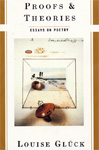
Proofs & Theories is a remarkable collection of essays in which Glück speaks candidly about her experience and thoughts on writing. I want to read these notes on craft not so much because she is a great essayist or critic, but because I value illumination into the mind of such a remarkable poet. Most striking to me was her essay, “Against Sincerity”–the very title seemed designed to shock. After all, I found myself ruefully laughing along with Li-Young Lee in an interview he gave with Rattle when he said:
I heard a poet say to me, ‘Oh, I hate sincerity.’ And I thought, oh, what do you like? Insincerity? I don’t get it.
I didn’t get it either. Perhaps partly because the title is so iconoclastic, Glück begins by defining terms, equating her use of the word sincerity with “telling the truth.”
Clearly, the truth is not always interesting. Nor can a poet force a reader to like a poem simply because “it really happened.” This seems to be the single greatest mistake of poets engaged with the personal lyric in our time.
Glück points out that a greater kind of “truth” can be had through a suspension of didactic conclusion, through exercising negative capability. She points out:
Keats’s theory of negative capability is an articulation of a habit of mind more commonly ascribed to the scientist, in whose thought the absence of bias is actively cultivated. It is the absence of bias that convinces, that encourages confidence, the premise being that certain materials arranged in certain ways will always yield the same result. Which is to say, something inherent in the combination has been perceived.
This is another angle on my own understanding that great poetry, in some sense, “executes” in the psyche much like software code runs in the context of computer hardware.
Interesting, also, is that Glück uses two sonnets to illustrate this capability, one from Milton, the other from Keats. This would seem to confirm Phillis Levin’s instinct in including one of Glück’s poems in her collection of Sonnets, and my own recognition of the sonnet’s influence on Glück’s ability to turn a line.
Above all, it was illuminating to read Glück espousing the greater “truth” that can be had through casting off any dogmatic adherence to fact or grasping after homily-like conclusion. What I sensed in a book like The Wild Iris was this kind of greater truth played out through the personae of plants. In a sense, Glück conceivably gives us, in some ways, a more accurate and intimate access to her inner life through this device. Though it is not in any way a factual autobiography, and though the speaker can never be said to necessarily equate to the author, this book of persona poems feels like a kind of “psychic autobiography.”
Glück confirms this as a possibility later in the collection when she writes about Eliot. Clearly, the character Prufrock is not the author Eliot–but Glück points out that Prufrock embodies many of Eliot’s concerns and that many of his later poems take the same kind of tone or voice as Prufrock. It is in this sense that exploring through negative capability helps a poet to arrive in truly unique and interesting territory–the questions that remain in the reader’s mind as perpetually more interesting than any statement of fact or any stroke, as it were, of “sincerity.”
Possibly Related Posts:


8 Comments
Be sincere but indirect without falling too far to convoluted, so as to let the reader flirt the meaning out. If a reader has to work thru allegory, or if the meaning can slip past the judgment intellect filter by symbolism, it can lodge deeper in the brain.
“a suspension of didactic conclusion” yes. Staid accurate homilies get no points for their truth because they don’t get far inside enough the mind to resonate. I could see that.
One must be interesting and speak of what stood out not that which was flat and common. It allows one to be more extreme and distorted than reality.
Would that be like saying caricatures are more representational than any photo since it highlights what is uncommon?
Elegiac works? here’s a review: http://www.whimsyspeaks.com/2007/06/
Thanks, Pearl. Pleasure as always to hear from you.
I’m not sure caricature works in the same way as persona – i.e. giving voice to aspect-perceptions that represent the “psychic autobiography.” The downside of caricature is the exaggeration of stock features (the big nose, the jutting chin) – but I would say distillation and essentialization is absolutely the stuff of lyric. Tricky – because when you talk about that as some kind of conscious effort, a game of what-to-hide and what-to-reveal with the reader, my experience is such a linear approach ends up clunkier than what happens on inspiration, what “comes together” as the intangibles you discover after the fact. So, I suppose when I talk about determinism I mean intention – not a linear plan but a direction of discovery, ending in a sense of sentience about the work, whose mechanics are only revealed in dissection – not assembly.
That makes sense. Certainly conscious poetry is clunky as thinking about how to walk.
Sense by sitting inside the negative capability of another, letting it wash in. By dissection or osmosis of reader of the unconscious intent of the writer.
If the writer’s hand is not firm enough or trained enogh, it can become automatic not to revealing truths but repeating cliches that come easily. By conscious practice of pruning, the suckers of these automatics can stay in control.
Indeed. That was always the problem I had with most literary criticism – it told you nothing about craft, only how to “murder to dissect” as it were. Stephen Booth’s approach is still the closest I’ve seen to a critical approach that benefits writers and keeps the work alive on the operating table.
I’m more in the Lee camp than the Gluck. I think, despite the merits of her work, it’s that refined reticence that’s holding her back, favoring an artifice that hurts her work.
Recently I quoted Rexroth on my blog, from his intro to DH Lawrence’s Selected Poems. He said that the ‘greatest poetry is nobly dishevelled’. Sometimes one must streak the naked truth.
Hi Jim,
One of the things I liked about this essay, once I got into Glück’s viewpoint, is that it did not seem to be divisive – that is, there seems no need to pick “camps” – any temptations in that regard are likely semantic. That said, I suppose the issue of control is a matter of taste, and while I favor noble dishevelment in theory, in practice I find Glück’s precision as elucidating as any rant.
Thanks for stopping by.
Cheers,
Robert
Robert,
I’m doing work on Keats’s Negative Capability, and so came across your post.
I’m especially interested in the way you see Gluck linking NC and the sonnet, and especially the sonnet’s turn. The turn is my other great critical interest (see my Structure & Surprise: Engaging Poetic Turns (Teachers & Writers, 2007)). I’ll have to look into this some more, but, initially, I like the idea that attention to turns can help to produce NC.
Your post was a fruitful find for me– Thanks!
Mike Theune
Hi Michael–
Thanks for taking the time to leave a comment. I haven’t read _Structure & Surprise: Engaging Poetic Turns_ yet, but if you are referring specifically to the volta, I can definitely see how that aspect of the form relates to NC. The ability to lay out a line of argumentation, often in an almost dialectic manner, and then flip both argument and counter argument into a more expansive view of both (a synthesis that is greater than the previous parts) certainly seems like an instrument of NC. Shakespeare, of course, was a master at this. Fun stuff.
Thanks for stopping by. Don’t be a stranger.