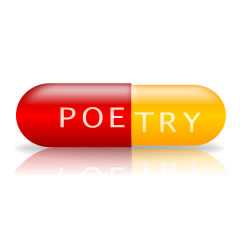
National Poetry Month Means Time to Take Your Vitamins

The Poetry Pill No, this is not an April fool’s post. Thanks to the Academy of American Poets, April is National Poetry Month, and apparently has been since 1996. Interestingly enough, according to some sources, April is also:

  • Health Awareness Month

  • National Blood Donor Month
  • National Oral Health Month

Notice a pattern? I do. National months are only declared for causes that socially-minded people think ought to receive more attention. That is to say, they are things we should pay more attention to–like our health, giving blood, recognizing the plight of others–good, noble causes that would simply get swept by the wayside were it not for (and sometimes still in spite of) assigning this cause to one of the twelve calendar months in an attempt to raise awareness.

In marketing there is the taxonomy of medicine, vitamins and candy. Any product is usually most like one of these three. Plumbing services to fix a broken pipe, for example, are medicine–fulfilling an immediate, expressed need. Cable Television is mostly candy–entertainment that looks and tastes good. A gym membership would be like vitamins. And poetry, unfortunately, by virtue of having been trotted out in classrooms on its national month once a year for the past eleven years, has proved itself to also be perceived most like vitamins–good for you, and you know it–but an awful lot harder to sell than medicine or candy.

There are, of course, some exceptions. In some instances, poetry is combined with dramatic performance and/or music to essentially sugar-coat the pill. Most vitamin companies bring out colorful, fun-shaped chewable vitamins for the same reason–because what is seen as candy is easier to sell. Still, while added dramatic and musical elements may create greater excitement in the moment, rarely do the texts of such poetic performances actually stand up on the page. And no matter how loudly the audience cheers, the content of such performances tend to be forgotten almost immediately after the show. Like candy, they are designed to excite–not nourish–and the bursts of energy they provide are often equally short lived.

After September 11th, 2001 a number of poetry compilations came out trying to offer words of comfort for troubling times. Publishers saw an opportunity to reposition poetry as medicine to the mainstream culture. The ripple, however, was slight. Increasingly, people seem to have replaced any genuine sense of the need for poetry with a sense that they ought to at least appreciate it (heaven forbid actually liking the stuff). Generally, those that do regard poetry as medicine have come to it their own way, and do not represent the majority.

The exception to the rule of an individual and minority relationship to poetry as need rather than should can be seen in the steady rise in MFA programs all over the country–a vote of confidence for reading and writing poetry that is being backed by cold, hard tuition money. And I doubt very much that students are enrolling in MFA programs because they feel, like taking vitamins, that they “ought” to get an arts degree. Getting an MBA is something you “ought” to do as a sensible career move. An MFA, to its students, is more likely either medicine or candy. I know which one it is for me.

So, maybe there is hope brewing yet that poetry can emerge from the vitamin shelf and figure more prominently in people’s lives. Mark Twain called a classic, “A book which people praise and don’t read.” Poetry has too long been an entire genre of writing which people likewise respect but rarely read. Given how much poetry matters to the health of human culture, here’s hoping for a time when every month can be poetry month and poems are generally regarded as more palatable than swallowing a large, jagged pill.

17 Comments

  1. Posted April 1, 2007 at 12:15 pm | Permalink

    Excellent metaphor, Robert. This medicine/vitamins/candy trio gives me a new model to play with as I navigate the world with my taxonomist glasses on.

  2. Robert
    Posted April 1, 2007 at 2:44 pm | Permalink

    Certainly useful to think about what ratios of each constitute the “product” you are trying to “sell.” (Even if it’s not a product per se and/or possibly free.) Helps to then be able to draw on all the precedents of vitamin, medicine and candy marketing campaigns we have already seen, and to posit the questions about how to shift perception from one type to another. Also, like all taxonomies, it is artificial and somewhat false.

  3. Posted April 1, 2007 at 4:51 pm | Permalink

    I’m glad you came across my site, Robert, so that I could come across yours. It will be good to have you to link to this month.

    And beyond of course.

  4. Robert
    Posted April 1, 2007 at 5:40 pm | Permalink

    Thanks, Dave. We’re here all month. :)

  5. Posted April 1, 2007 at 6:10 pm | Permalink

    I’m not sure that for me, poetry falls into either the “vitamin” or “candy” category, strictly speaking…it’s something I enjoy but I wouldn’t see it as “candy” (“Candy” for me carries the implication that it’s enjoyable but perhaps not that sustaining or good for you in the long run…cable tv is probably a good example).

    Perhaps there’s a fourth category? Something like “homemade bread” or “fresh garden tomatoes” that are both health-enhancing and enjoyable? Because I know poetry (at least the good stuff) is “good for me,” I can feel my brain expand when I read it. But I also enjoy it; it makes my life richer.

  6. Robert
    Posted April 1, 2007 at 7:33 pm | Permalink

    Hi Erica,

    Mmmm… fresh bread. Certainly a good metaphor for certain poems. In fact, it was Mary Oliver, I believe at the end of her Poetry Handbook, that called poetry something like, “bread in the pockets of the hungry.”
    I have sometimes heard of “food” as a category in this taxonomy. They’re all artificial designations, of course, all designed just as sort of elemental categories to help you think about aspects of a “product” and how best to “sell” it.

    I like the idea of food in relation to poetry, since there’s such a wide variety of it – and I’ve certainly gone in to some poems expecting a French meal only to end up with a mouth full of greasy french fries. Not a happy meal.

    Thanks for stopping by.

    Best,
    Robert

  7. Posted April 2, 2007 at 9:05 am | Permalink

    Luckily enough people fatigue of fat and sugar the same way they fatigue of sensory overload and simple comforting poems. Something about the sense of excitement and vigor lingers and that can be a gateway drug to less mainstream poems. Instead of a vitamen supplement, they can start seeking out conceptual nutrition in the raw veggie, so to speak.

  8. Robert
    Posted April 2, 2007 at 10:04 am | Permalink

    Hi Pearl – nice to “see” you as always.

    I wish there were some kind of invisible hand of healthy aesthetic – or at least that we were better at paying attention to our personal barometers. But at least in this country, we have a high incidence of obesity and type-2 diabetes. Which means sugar and fat aren’t always self-limiting. Seems particularly a problem in environments where healthy alternatives either aren’t readily available, or have a reputation of being unpalatable (eww, spinach!)

    So, it seems to be all about perception and availability – the stuff of marketing, in general, and this particular venture called Natioal Poetry Month in particular.

    Love the idea of the gateway drug. I’ve seen that in action.

  9. Posted April 2, 2007 at 12:44 pm | Permalink

    NaPoMo rated – somewhere between National Root Canal Month & National Enema Month? :-)

  10. Robert
    Posted April 2, 2007 at 12:54 pm | Permalink

    Well, I was trying to avoid the “poetry as suppository” category altogether – but we went there. I just look at that big image of a capsule with POETRY on it and think: this must how some people feel about it – take this lyric and shove it.

    Thanks for stopping by. Bet you’re sorry you did. :)

  11. Posted April 4, 2007 at 2:23 pm | Permalink

    Hey Robert, thanks for stopping by my blog. I also enjoyed your poetry/medicine analogy. Here’s to hoping for a future where poetry isn’t just a supplement but an essential part of a balanced meal. :)

  12. Robert
    Posted April 4, 2007 at 2:28 pm | Permalink

    I can just hear Mr. Voiceover Man now – saying, “Fortified with Vitamin P – an essential part of this healthy breakfast,” as the camera pans over a bowl of cereal, glass of juice and The Complete Works of Dylan Thomas (or some such).

    Don’t be a stranger.

  13. Posted April 4, 2007 at 4:04 pm | Permalink

    You are NOT among my Echoing Voices, instead you are among my Art and Words on the sidebar… That’ll assure that the voices do not say “I am Robert Peake”…It’s not a 100% guarantee that they won’t still utter those four words, but the likelihood is quite diminished- (Out of site out of mind so to speak.)

  14. Posted April 4, 2007 at 9:53 pm | Permalink

    >Mark Twain called a classic…

    Last summer I started reading (in a completely different way than I did before) classic novels. It may sound naive or pretentious, but I was I amazed what a great novel can really mean & do.

    Now I’m easing into poetry, and finding some of the same experiences.

  15. Robert
    Posted April 4, 2007 at 11:14 pm | Permalink

    I think that moment when a work of literature strikes you as art, rather than just entertainment, is really profound – when you realize there is so much more going on, that you close the pages and look at your life and your world a little differently.

  16. Posted April 5, 2007 at 8:24 am | Permalink

    Hi Robert,

    Thanks for your comment on my blog. I enjoyed reading this post. No doubt you’ve seen the graphic on the Poets.org site: http://www.poets.org/poemADay.php . It certainly supports the poetry-as-medicine concept. A bitter pill to swallow?

    I like the food metaphor above a lot better.

  17. Robert
    Posted April 5, 2007 at 8:40 am | Permalink

    Thanks for stopping by, Ruth. I came across that pill-box image just yesterday, long after I designed the big pill graphic on this page. You know you’re too connected to the online world when you start picking up ideas from web pages you’ve never visited. :)

Post a Comment

Your email is never shared. Required fields are marked *

*
*


Popular Tags

Academia Academy Of American Poets Accessible Poetry Adam Zagajewski Aliso Street Bear Andrew Philip Anna Akhmatova Arroyo Arts Collective Artists' Union Gallery Art Therapy Avant Garde B.H. Fairchild Bart's Books Bell Arts Factory Blogging Code Poet Conservation Czesław Miłosz David Allen Day Fire Denise Levertov Dorianne Laux Facebook First Books Friday Lubina Galway Kinnell George Wallace Gerard Manley Hopkins Gregory Orr GTD Gwendolyn Alley Heart And Mind Henri Cole Hope Jackson Wheeler James Valentine Peake Japan Jawanza Dumisani John Ashbery John Keats Joseph Millar Kathleen Tyler Li-Young Lee London Los Angeles Louise Glück Low-Residency MFA Mark Doty Marriage Marvin Bell Mary Oliver Merlin Mann MFA Residency 1 MFA Residency 2 MFA Residency 3 MFA Residency 4 MFA Residency 5 Michael Wells Michelle Bitting Miranda Nature Negative Capability Ojai Ojai Poetry Festival Pacific University Passings Performance Poetry Phil Taggart Poetry In The Windows Polish Poetry Post-Postmodernism Ralph Waldo Emerson Rattle Read Write Poem Robert Hass Robert Pinsky Sandford Lyne Sandra Alcosser Sarah Maclay Seamus Heaney Social Networking Sonnets Spirituality Stanley Kunitz Stephen Booth Stephen Dunn Suzanne Lummis The Economy The Phoenix The World Stage Tree Bernstein Twitter Umberto Saba Wallace Stevens Why Poetry Zbigniew Herbert ZCE Zen Zoey's Cafe