Freedom in Flarf

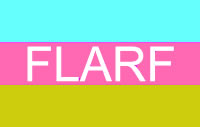
“The Flag of Flarf,”
in all its clashing-color glory
(cyan, hot pink, and caca d’oie)

I never quite understood flarf. For awhile, I thought people were writing it to send in to vanity contests to prove the contest standards were laughably low (a kind of analogue to 419-baiting). I thought it was purely a ruse. Having a go amidst some lively banter over on Amy King’s blog has convinced me otherwise. I think flarf can be good for so-called serious poets who are dedicated to other modes–and even liberating.

There is a story, perhaps apocryphal (scroll down), that Abraham Lincoln encouraged at least one member of his staff on one occasion to write an angry letter and burn it, and that he did so himself as a therapeutic exercise. I have certainly done something similar (akin to Cameron’s “morning pages”) and found great benefit. It occurs to me that if being free to write a diatribe full of unsavory and inappropriate comments can actually make you a better diplomat, perhaps being free to write really bad poetry complete with similar trappings can actually make you a better poet.

Poetry can become so serious.

By trying to be bad, the limitation of success is immediately lifted. The only way to succeed is to try hard not to succeed, to get all the worst tricks, the farthest leaps, the most shocking words and least likely turns of phrase out of one’s system. Whether or not this stuff should be published, of course, depends on how good you are at spotting the beauty in badness. Yet sharing flarf can be liberating as well–especially when good poets show off bad stuff.

Spending so much time on the right words and phrasing and tone and texture (and etc.) of a piece can be exhausting. In the end, we can come to crave a tantrum of badness to balance the scales–and flarf is a perfect outlet. So go on–be bad. Really bad. How low can you go?

Similar Articles:

  1. The Pleasures of Frustration in Poetry

Liked this? Receive new ones in your inbox.

(You can unsubscribe any time.)


  • http://zyzzyvaspeaks.blogspot.com/ howard junker

    dude:

    it would have been, and still could be, nice if you would acknowledge your flarf rant as being inspired, however distantly, by my post of 16 Feb.

    adelante,
    howard

  • Robert

    Hiya Howard,

    Thanks for stopping by. I read your post when it came out last month (ah, the wonders of RSS) and definitely enjoyed it enough to revisit it today (thanks to Google BlogSearch).

    So, your post certainly inspired my thoughts as much as everything else rattling around in my subconscious over the last month, and thanks for that. The experience that catalyzed my post, above (can one rant in approbation?), was a discussion on Amy King’s blog and my experience of (finally) actually trying out the form.

    Thanks also for the peek you provide, through your blog, into the that flagship poetry small press.

    Vorwärts,
    Robert

  • Robert

    p.s. and continuing in the theme of hat-tips, I gotta give it to this site:

    http://mainstreampoetry.blogspot.com/

    which not only cranks out flarf (and flarf video) but thereby manages to attract spambots in droves. Could this be flarfetic justice?

  • http://www.collinkelley.blogspot.com Collin Kelley

    Call me “old-fashioned” (the horror…the horror), but I’ve never been able to get into the whole flarf movement. Some of it is so bad it’s hilarious, but trolling Google for random spam and words just isn’t my idea of fun. I’m trying to spend more time away from the computer when I’m writing poetry these days. I’ve actually gone back to writing first drafts in a notebook. I’m positively retro at this point…and probably an elitist snob. ;-)

  • Robert

    Collin, I looked up elitist in the dictionary – and there you were, with a feather pen in hand, writing on a parchment scroll! :)

    Seriously, I go analog myself when it comes to poems, and get enough spam in my inbox as it is. I guess just writing flarf in the sense of “trying to be so bad it’s good” (sans the Googling) was a kind of liberating experience for me.

  • http://pearlformance.livejournal.com Pearl

    Thanks for that intro. I couldn’t really get under flarf either but I’m closer.

    Interesting concept. Neat Abe story.

  • http://pearlformance.livejournal.com Pearl

    Yes, reading the Amy King post comments helped.

  • Robert

    Hey Pearl – nice to “see” you again. Love it when it turns out others have come to similar tactics regarding the inner game of writing (or living, or whatever). Especially someone like Abe. Hope you are well.

  • jenni

    i don’t get flarf. i don’t get why people would even waste their time. to me, it’s not even worth thinking about. but hey, i’m a bitch! LOL

  • Robert

    Well, what I found is that trying hard to be bad can be a useful exercise. Knowing what’s bad actually helps me know what’s good. Plus, as Marvin Bell once said (I’m paraphrasing), it’s often not the bad stuff that needs to be cut out to make a poem good – but amplified and improved to ultimately make the poem actually great.

  • http://www.amyking.org/blog amy

    Ha! It sounds like Howard might want to read Barthes’ Death of the Author — I don’t really get any credit for Flarf ultimately, since I merely responded to some silly declarations and made a lame ass effort to try out the form too!

    xo, Howard! You’re just as on it as the next guy…

    Amy

  • Robert

    Thanks for stopping by, Amy. Here’s to the enlightenment through lame-ass efforts.